



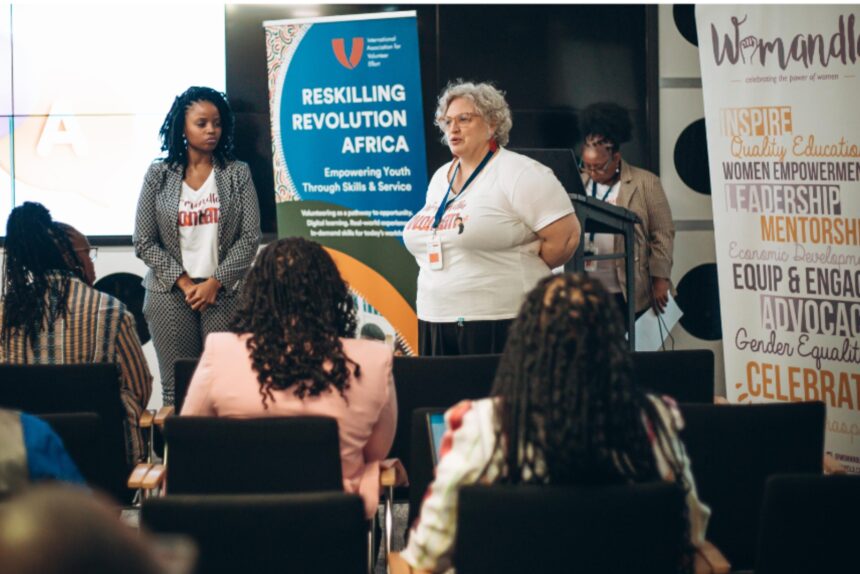
As automation and artificial intelligence continue to reshape entry-level work globally, a new phase of the Reskilling Revolution Africa initiative has been launched in South Africa, targeting women and young people at risk of being left behind.
The programme is being rolled out by the Womandla Foundation in partnership with the International Association of Volunteer Effort (IAVE) and IBM SkillsBuild, a free digital learning platform developed by IBM.
Phase Two expands the initiative’s footprint in South Africa at a time when youth unemployment remains among the highest in the world and concerns about automation-led disruption are intensifying.
“At IBM, we believe that access to technology skills is a catalyst for inclusive economic growth,” John Matogo, corporate social responsibility leader for IBM Middle East and Africa, said.
What You Need to Know
Reskilling Revolution Africa was endorsed by the African Union in 2023, signalling political recognition of the need for urgent skills transformation across the continent. Its pilot phase, launched in late 2024 in Nigeria, Ethiopia and South Africa, reached approximately 30,000 young people.
Participants enrol through local non-governmental organisations and complete curated learning pathways on IBM SkillsBuild, covering digital literacy, artificial intelligence, cybersecurity, entrepreneurship and soft skills.
Learners earn globally recognised certificates and combine self-paced online study with mentorship, volunteering and community-based projects designed to improve employability.
Phase Two in South Africa introduces expanded course offerings, including AI and green skills, reflecting both technological and sustainability priorities. Cohorts will run for eight to ten weeks, supported by mentoring and post-training guidance aimed at translating credentials into employment, entrepreneurship or further study.
Confronting a Youth Employment Crisis
The launch comes against a stark labour market backdrop. South Africa’s youth unemployment rate for those aged 15–24 stands at nearly 59 per cent, one of the highest globally.
While it remains difficult to isolate the precise role of AI in domestic retrenchments, layoffs across white-collar sectors in the United States surged in 2025 amid accelerating automation, a trend many analysts expect to diffuse globally.
In South Africa, sectors such as business-process outsourcing (BPO) and call centres remain particularly exposed.
Automation technologies are advancing rapidly in these industries, even as human labour still performs much of the operational workload. Without strategic intervention, analysts warn, the country could face intensified displacement pressures.
Bridging the Alignment Gap
A recurring theme within the Reskilling Revolution initiative is structural misalignment. Education and policy cycles often move in multi-year increments, while AI capability cycles evolve within months.
“We should pay less attention to predicting job loss numbers and focus more on building adaptive learning ecosystems fast enough to keep up with technological change,” Sam Gqomo, the founder of Womandla Foundation, said.
Gqomo noted that Womandla currently offers around 36 free learning pathways across entrepreneurship, Science, Technology, Engineering and Mathematics (STEM), and the creative industries, spanning beginner to advanced levels.
“This collaboration demonstrates what becomes possible when technology, volunteering and purpose-driven partnerships align,” said Samuel Turay, Africa Senior Program Manager from IAVE. “Together, we are creating practical pathways that empower people to participate meaningfully in the economy.”
Short training programmes and digital certificates, though increasingly relevant to employer demand, are still not fully recognised within many formal hiring systems. This limits mobility for young people who have acquired skills through informal or self-directed pathways, even as employers report shortages in precisely those capabilities.
The programme’s success will therefore depend not only on course completion rates but also on broader structural shifts, including expanded broadband access, affordable devices, inclusive STEM pipelines and policy recognition of non-traditional learning routes.
A Structural Choice for South Africa
South Africa now faces a strategic crossroads familiar to many emerging economies, whether automation will widen inequality or drive productivity-led inclusion.
Without targeted interventions, AI adoption could concentrate opportunity among already connected urban youth while displacing routine workers. With supportive policies such as rural digital hubs, broadband expansion and skills-based hiring incentives, the same technologies could broaden participation and stimulate growth.
“Africa is the youngest continent in the world,” Khadija Richards, head of impact at Womandla, said. “ Young people are already digitally adaptive, entrepreneurial and comfortable navigating change. When AI moves quickly, youth are often the first to experiment with it.”
As Phase Two of Reskilling Revolution Africa begins, the initiative positions itself not merely as a training programme, but as part of a broader effort to recalibrate how education, policy and labour markets respond to accelerating technological change.
Talking Points
It is encouraging to see the Womandla Foundation leading Phase Two of Reskilling Revolution Africa at a time when youth unemployment and automation pressures are converging in South Africa.
The collaboration with the International Association of Volunteer Effort and IBM SkillsBuild demonstrates the power of aligning technology, volunteering and purpose-driven partnerships. This multi-stakeholder model increases the likelihood that training translates into real economic participation.
At Techparley, we see strong value in the programme’s blended approach, combining self-paced digital learning with mentorship, volunteering and community projects. This bridges the common gap between certification and practical experience, which often limits youth employability.
The expansion into AI and green skills is particularly timely. As automation reshapes routine work, early exposure to AI fluency and emerging sectors can position young South Africans not just as job seekers, but as innovators and digital entrepreneurs.
However, training alone will not solve structural unemployment. The real test will be whether employers recognise alternative credentials and whether policy frameworks evolve to support skills-based hiring rather than purely degree-based filters.
There is also an opportunity to deepen rural inclusion. Connectivity access, affordable devices and local digital hubs will determine whether this initiative reaches beyond already-connected urban youth. With the right ecosystem support, the programme has the potential to shift South Africa’s automation narrative from displacement to adaptation and productivity growth.
——————-
Bookmark Techparley.com for the most insightful technology news from the African continent.
Follow us on Twitter @Techparleynews, on Facebook at Techparley Africa, on LinkedIn at Techparley Africa, or on Instagram at Techparleynews.