



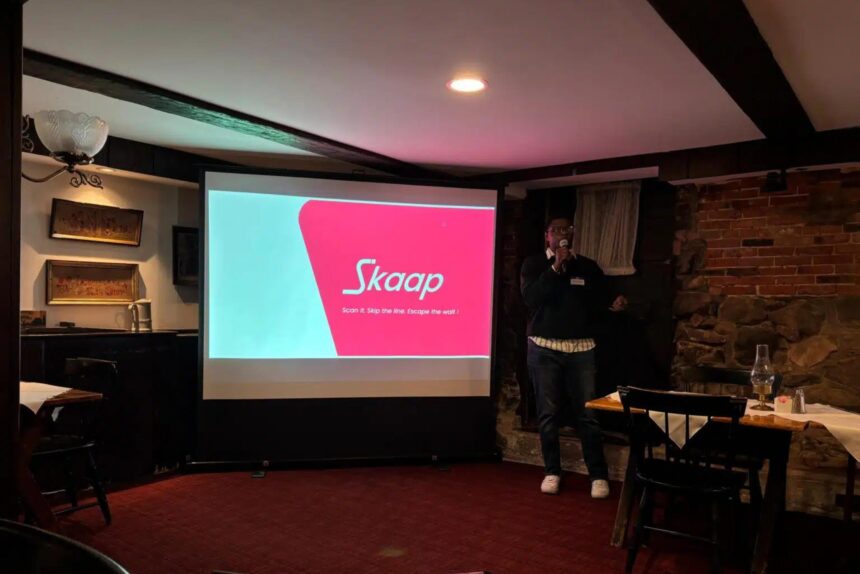
Long queues, crowded aisles and slow checkouts are a universal frustration for shoppers and a costly headache for retailers. For Samuel Ayo Oyedemi, the solution is to let customers scan, pay, and walk out. This drove Oyedemi to develop SKAAP, a mobile scan-and-go platform designed to make checkout seamless for small and medium-sized stores.
What sets SKAAP apart is its focus on accessibility and practicality. Rather than replacing existing systems, the app sits on top of a store’s current inventory, offering frictionless shopping without expensive hardware.
After testing in Canada, Oyedemi is now preparing to take SKAAP to the United States, aiming to bring the convenience of self-checkout to markets where higher foot traffic and tech-savvy shoppers can fully embrace it.
“I saw a company in Nigeria doing something similar, and I said to myself, if this technology can exist there, then there’s definitely a problem worth solving,” he said.
From Agege to Saskatchewan
Oyedemi’s entrepreneurial instincts were forged early. Raised in Lagos in a household where enterprise was less ambition and more necessity, he began selling doughnuts in secondary school, earning as much as ₦2,500 per week.
He washed cars, co-founded a borehole installation business with his father, experimented with an adire clothing venture that failed and ran a small lending operation with his mother.
He later worked at Access Bank, gaining exposure to financial systems and investment dynamics before relocating to Canada in 2023.
His first role abroad was a commission-based sales job for a US start-up expanding into Canada. The experience, he says, underscored a key cultural insight: trust is paramount in the Canadian market.
A subsequent stint at athletic apparel giant Lululemon would prove decisive. During a peak holiday rush, customers queued for up to 30 minutes to pay. Using a mobile point-of-sale device, Oyedemi assisted one shopper who exited the store in roughly ten minutes. That moment crystallised the idea of self-checkout, but simplified and decentralised.
How SKAAP Works
SKAAP’s proposition is straightforward. Upon entering a participating store, shoppers scan a QR code unique to that location. This connects them to the store’s live inventory within the app. As they select items, they scan each product and add it to a digital basket.
When finished, users pay instantly via a connected payment method. An exit pass is generated to confirm that payment has been made.
Oyedemi describes the experience as “scan, skip, escape”.
Yet theft prevention remains a persistent challenge in the self-checkout space. Jump n Pass faced similar concerns in Nigeria, at times relying on attendants to verify purchases, a workaround that diluted the frictionless premise.
SKAAP’s early trials suggest retailers are still adjusting to the idea of customers independently scanning and leaving without traditional oversight.
During beta testing across approximately 10 stores in Calgary, Edmonton and Saskatchewan, the company onboarded around 200 users. However, transaction volumes remain modest.
“Transaction volume has not been the highest. The focus has been on a frictionless experience. It is important to get local retailers comfortable with someone just walking in, scanning, and leaving,” he said.
The product has undergone several iterations. A dedicated SKAAP QR code at store entrances was introduced to prevent misuse and confusion. The company has also refined the user interface to appeal to younger shoppers.
Rather than building a full inventory management system, SKAAP now positions itself as a lightweight layer atop existing retail infrastructure, surfacing insights such as fast-moving and slow-moving stock without replacing core systems.
Competing in a Crowded Market
Scan-and-go is not new in North America. Major retailers including Walmart, 7-Eleven, Sam’s Club, BJ’s Wholesale Club and U-Haul offer versions of the technology within their proprietary apps.
But these systems are typically closed ecosystems. A shopper must download and use each retailer’s individual application.
“If Walmart has its own app and 7-Eleven has its own app, you can’t expect people to download 20 different apps just to shop,” Oyedemi argued.
SKAAP’s ambition is not to compete directly with retail giants, but to provide affordable self-checkout technology for small and medium-sized stores that lack the capital for expensive hardware installations.
“Self-checkout machines are very expensive, and small to medium retailers can’t afford to have multiple machines in their stores, so we are their cost-effective option,” he said.
Why the United States?
Early milestones included acceptance into Saskatchewan’s Cultivator programme and later into DMZ, often described as Canada’s equivalent of Y Combinator.
However, market dynamics prompted a strategic reassessment.
Oyedemi cited Canada’s relatively low population density compared with the United States. Lower density often translates to reduced foot traffic per store, limiting transaction frequency, a critical variable for checkout solutions.
As a result, SKAAP is preparing to enter the US market in the second quarter of 2026. The company plans to monetise through subscription fees charged to retailers.
To date, SKAAP has not raised external investment. Whether the American retail landscape will embrace a solution that struggled to gain widespread traction in Nigeria remains an open question.
What is clear, however, is that the experiment is far from over. For Oyedemi, the lesson from Nigeria was not that scan-and-go failed, but that context matters. In retail technology, timing, density and consumer behaviour can determine whether frictionless shopping remains a concept or becomes the norm.
Talking Points
It is notable that Samuel Ayo Oyedemi is revisiting the scan-and-go retail model with SKAAP, taking lessons learned from Nigeria and adapting them for North American markets. The platform addresses a persistent pain point in retail: long queues and friction at checkout.
By allowing customers to scan, pay, and exit using a mobile app, SKAAP promises a seamless shopping experience that reduces reliance on traditional cashiers and self-checkout hardware. This makes it a practical solution for small and medium-sized retailers that cannot afford expensive checkout machines.
At Techparley, we see how platforms like SKAAP could accelerate the adoption of frictionless retail technology in markets beyond dense urban centres, particularly where smaller stores form the backbone of local commerce.
The decision to position SKAAP as a lightweight layer on top of existing inventory systems rather than a full replacement shows strategic pragmatism. Retailers can adopt the technology without overhauling operations, while the platform still delivers insights into inventory movement and fast-selling products.
As SKAAP prepares to expand into the United States, there is a clear opportunity to scale the model in markets with higher population density and greater foot traffic. Strategic partnerships, retailer education, and local adaptation will be key to making frictionless shopping a practical reality beyond Canada.
——————-
Bookmark Techparley.com for the most insightful technology news from the African continent.
Follow us on Twitter @Techparleynews, on Facebook at Techparley Africa, on LinkedIn at Techparley Africa, or on Instagram at Techparleynews.