



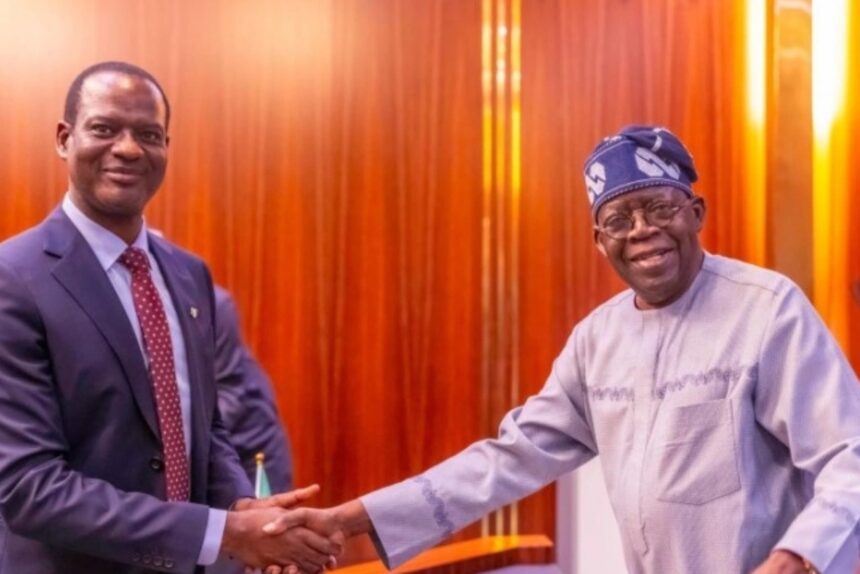
With a move that underscores Nigeria’s renewed focus on fiscal reforms and economic stability, President Bola Tinubu has sworn in Taiwo Oyedele as Minister of State for Finance. The appointment reflects a strategic decision rooted in competence, experience, and reform-driven leadership.
The swearing-in ceremony, held at the Presidential Villa in Abuja, shows what the Presidency calls a “vote of confidence” in Oyedele’s capacity to drive fiscal transformation at a critical moment for Africa’s largest economy.
With over two decades of experience in tax policy, fiscal governance, and economic advisory, Oyedele’s transition from Chairman of the Presidential Committee on Fiscal Policy and Tax Reforms to a key player within the Finance Ministry signifies continuity in Nigeria’s reform agenda.
The President, in a statehouse press released on Monday, praised his “knowledge, simplicity, ambition, and excellence,” while Oyedele himself framed the appointment as “not merely a personal milestone; it is a call to greater service,” highlighting the weight of expectations tied to his new role.
The Swearing-In and Presidential Endorsement
The formal induction of Oyedele into the Federal Executive Council was marked by strong commendation from President Tinubu, who emphasized the technocrat’s track record and reform credentials.
According to the State House, the President described the appointment as a deliberate choice informed by Oyedele’s performance in leading Nigeria’s tax reform efforts.
“We are very proud of your knowledge, your simplicity, ambition, and excellence,” Tinubu said, underscoring the confidence placed in the new minister.
The President further highlighted Oyedele’s instrumental role in reshaping Nigeria’s fiscal architecture, particularly through reforms aimed at simplifying the tax system, expanding the revenue base, and fostering a more business-friendly environment.
He noted that Nigeria’s previous tax framework had been “obsolete and fundamentally against every progressive thinking,” adding that Oyedele’s contributions were central to repositioning the system for growth.
Tinubu also acknowledged the complexity of the role, describing it as “a very challenging job” given Nigeria’s current economic reality, marked by relative stability but lacking exponential growth.
Nevertheless, the president expressed confidence in Oyedele’s suitability, stating, “It didn’t take much for me to decide where you fit and where you need to be to further help with the economy”.
The Newly Appointed Minister’s Response: A Call to Service
In his response, shared via LinkedIn, Oyedele adopted a tone of humility and national duty, positioning his appointment as an opportunity to serve rather than a personal achievement.
“Today, I had the honour of being sworn in as Minister of State for Finance of the Federal Republic of Nigeria,” he wrote, expressing gratitude to President Tinubu for the trust placed in him and to the Senate for confirming his nomination.
He was deliberate in framing the broader significance of his role, noting that “this appointment is not merely a personal milestone; it is a call to greater service.”
The newly appointed minister acknowledged the dual realities facing Nigeria, fiscal challenges on one hand and immense opportunities on the other, while emphasizing the long-term implications of public finance decisions.
“The decisions we make in public finance today will shape the prosperity, stability, and well-being of our country for generations to come,” he stated.
He concluded by reaffirming his commitment to public service values, stressing that “public service demands integrity, humility, and dedication,” and pledging to approach the role with “a deep sense of duty and commitment to Nigeria and the Nigerian people”.
Policy Priorities: Revenue, Discipline, and Impact
A key highlight of Oyedele’s statement is the clarity of his policy direction. In outlining his immediate focus, he identified three critical priorities, strengthening revenue mobilisation, promoting fiscal discipline, and ensuring that public resources translate into tangible improvements in citizens’ lives.
“In my new role, I will focus on supporting efforts to strengthen revenue mobilisation, promote fiscal discipline, and ensure that public resources translate into real improvements in the lives of Nigerians,” he said.
These priorities align closely with ongoing reforms initiated under the Presidential Committee on Fiscal Policy and Tax Reforms, suggesting a continuity of strategy within the Finance Ministry.
Oyedele also emphasized collaboration as a cornerstone of his approach. He expressed readiness to work with the Honourable Minister of Finance and Coordinating Minister of the Economy, as well as stakeholders across government, the National Assembly, private sector, and development partners.
This multi-stakeholder engagement reflects an understanding that fiscal reform is not solely a government function but a collective effort requiring alignment across sectors.
Short Note on Oyedele’s Background and Expertise
Oyedele brings to the role a robust blend of professional, academic, and policy experience. An economist, accountant, and public policy expert, he has spent over 22 years at PricewaterhouseCoopers, where he rose to become Fiscal Policy Partner and Africa Tax Leader.
In this capacity, he advised both public and private sector clients on tax strategy, policy design, and economic planning across the continent.
His academic credentials include a Higher National Diploma in Accountancy and Finance from Yaba College of Technology and a Bachelor’s degree in Applied Accounting from Oxford Brookes University. He has also completed executive education programmes at globally renowned institutions such as the London School of Economics, Yale University, and the Harvard Kennedy School.
Beyond his corporate career, Oyedele is deeply involved in academia and social impact. He serves as a Professor of Practice at Babcock University and a guest lecturer at Lagos Business School, where he contributes to the development of future leaders in fiscal policy and development finance.
He is also the founder of Impact Africa Foundation, a non-profit organization focused on education financing, youth empowerment, and social development initiatives.
Why This Appointment Matters for Nigeria’s Economic Revival
Oyedele’s appointment comes at a pivotal moment in Nigeria’s economic trajectory. As the country grapples with the need to deepen revenue generation, reduce fiscal deficits, and stimulate sustainable growth, the integration of a technocrat with hands-on reform experience into the Finance Ministry speaks of a deliberate policy direction.
Having played a central role in designing Nigeria’s recent tax reforms, Oyedele’s new position enables him to transition from policy formulation to implementation, an often critical gap in public sector reform. His appointment therefore represents not just continuity, but an opportunity to accelerate execution and deliver measurable outcomes.
President Tinubu’s remarks further highlight the strategic importance of this transition, particularly in a context where “economic stability is being experienced, but without exponential growth”.
By placing a reform-minded expert within the finance leadership structure, the administration appears to be strengthening its capacity to navigate this delicate balance.
Ultimately, Oyedele’s blend of technical expertise, policy experience, and collaborative outlook places him as a key figure in Nigeria’s ongoing efforts to build a more resilient, transparent, and growth-oriented fiscal system.
As he steps into this role, Nigerians’ expectations remain high that his contributions will help translate policy ambition into tangible economic progress for millions of Nigerians.
Talking Points
The appointment of Taiwo Oyedele as Minister of State for Finance speaks of a calculated shift by President Bola Tinubu toward embedding technocratic expertise at the heart of Nigeria’s fiscal management, but its ultimate success will depend less on credentials and more on execution within a complex political economy.
Oyedele’s transition from policy architect, having led tax reform design, to policy implementer is both a strength and a risk, while it ensures continuity and deep institutional knowledge, it also exposes him to the entrenched bureaucratic resistance and political trade-offs that often dilute reform outcomes.
His emphasis on revenue mobilisation and fiscal discipline is sound, yet Nigeria’s structural challenges, such as a narrow tax base, widespread informality, and public distrust in government spending, mean that technical solutions alone may not yield immediate results without parallel governance and accountability reforms.
Furthermore, his collaborative tone sends awareness of the need for multi-stakeholder alignment, but coordination across ministries, the legislature, and private sector actors has historically been uneven.
In essence, while Oyedele’s profile suggests strong potential to drive meaningful change, the real test will be whether he can convert reform blueprints into measurable economic impact in a system where policy ambition often outpaces implementation capacity.
________________________
Bookmark Techparley.com for the most insightful technology news from the African continent.
Follow us on X/Twitter @Techparleynews, on Facebook at Techparley Africa, on LinkedIn at Techparley Africa, or on Instagram at Techparleynews