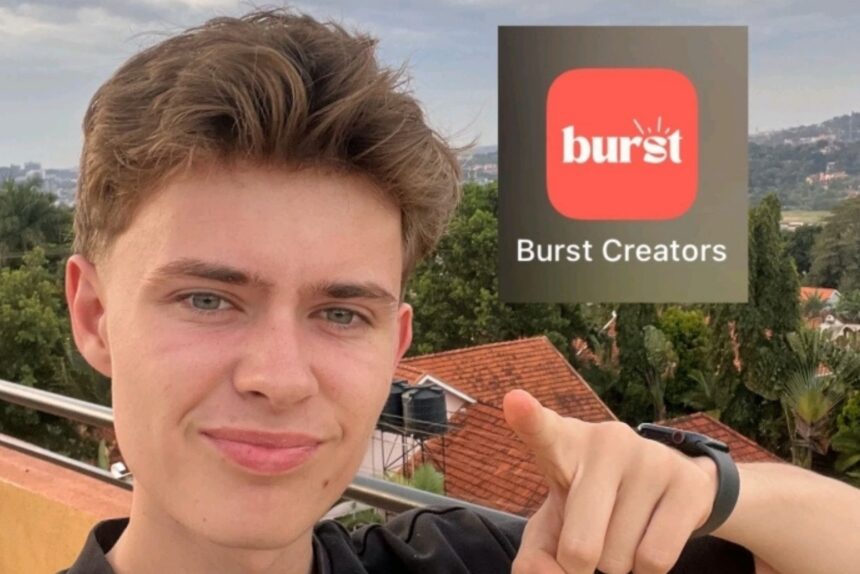
Ugandan startup, Burst Creators, a performance-based influencer marketing platform is challenging traditional influencer marketing models by allowing brands to pay only for actual views generated by content, while enabling creators to earn based on measurable performance rather than follower counts alone.
Originally founded in Denmark in 2024 and later introduced to Uganda by entrepreneur Isak Bjerregaard after acquiring the platform’s distribution rights, Burst Creators has quickly gained traction in East Africa’s emerging creator economy.
Through a dual-product ecosystem comprising a brand platform and a creator application, the startup is seeking to solve longstanding inefficiencies in influencer marketing, including inflated creator rates, opaque campaign reporting, and the absence of reliable performance measurement tools.
With more than 15,000 app downloads, over 17 million campaign views generated, more than UGX100 million paid to creators, and expansion plans targeting Kenya and other African markets, Burst is betting that performance-driven influencer marketing could become a defining feature of Africa’s digital economy.
What Problem is Burst Solving?
For years, influencer marketing across many African markets has operated largely on trust, assumptions, and unverifiable metrics. Brands often negotiated fees based on follower counts rather than actual engagement, while agencies added additional markups that increased campaign costs without necessarily improving outcomes.
At the same time, content creators frequently lacked standardized benchmarks for pricing their services, resulting in inconsistencies that made the market difficult to navigate for both sides. According to Burst partner Tobias Mørch-Hansen, these inefficiencies represented a major gap in the market.
“Influencer marketing in Uganda ran on guesswork. Creators, without any real benchmark for what to charge, inflated their rates. Agencies piled on their own markup when brands came asking. And reporting? Brands got screenshots, often tampered with, and were expected to trust them,” he explained.
He added that the lack of accountability created uncertainty for advertisers.
“There was no way to know if the money was actually doing anything. And nobody in the market seemed bothered by that.”
Burst aims to address these challenges by introducing transparency and measurable performance into the influencer marketing process. Instead of paying simply because content is posted, brands pay for actual views, creating a system where every stakeholder is incentivised to focus on meaningful engagement and results.
How It Works: For Brands and Creators
At the core of Burst’s offering is a technology platform designed to simplify influencer marketing while making campaign performance fully transparent.
For brands, the platform functions as a centralized campaign management system. Companies can browse creators, review audience demographics and engagement insights, launch campaigns, and monitor performance through a live dashboard.
The platform also allows brands to manage comment sections on campaign videos directly and provides built-in fraud detection tools capable of identifying attempts to artificially inflate view counts.
Perhaps most importantly, brands are only charged for views generated by approved content, eliminating the uncertainty often associated with traditional influencer marketing arrangements.
On the creator side, Burst offers a mobile application where influencers can discover paid opportunities. Creators browse active campaigns, apply for projects that align with their audience and interests, and upload content for approval.
Once approved, the content is automatically published on platforms such as TikTok and Instagram, while earnings accumulate within the app and can be withdrawn by creators at their convenience.
“The simplest way to explain how it works is through a real campaign,” Mørch-Hansen said.
He pointed to a campaign conducted by SafeBoda for its SafeCar service in December, involving eight creators and a budget of UGX1.5 million (approximately US$400).
“Because creators on Burst only earn when people actually watch their video, they made content people actually wanted to watch,” he said.
While the campaign initially targeted around 60,000 views, the creators ultimately generated more than three million views. According to Burst, the campaign’s effective cost-per-thousand impressions (CPM) came in at roughly UGX497, significantly lower than the campaign’s original pricing expectations.
The Creators’ Benefit Angle
One of Burst’s most notable contributions may be its ability to create earning opportunities for smaller creators who are often overlooked by brands and agencies.
Traditional influencer marketing frequently favors influencers with large follower counts, regardless of engagement quality.
As a result, thousands of creators with loyal and active audiences struggle to secure paid partnerships because they do not meet arbitrary follower thresholds, and Burst seeks to change that dynamic.
“The milestone we’re most proud of isn’t a number,” Mørch-Hansen said. “Creators with between 10,000 and 50,000 followers, the ones traditional brand deals ignore because their follower count doesn’t look big enough on paper, are now making real, regular income from their content. That wasn’t possible before Burst.”
The startup reports that more than UGX100 million has already been paid to creators through the platform. Much of its growth has also been driven organically through creator testimonials and word-of-mouth referrals.
“Creators who got paid, saw it was real, and made testimonial videos off their own back. That brought in more creators,” Mørch-Hansen explained.
Today, Burst’s network includes more than 600 approved creators in Uganda and over 200 creators in Kenya, demonstrating growing demand among digital creators for performance-based monetization opportunities.
How Burst Creators Makes Money
Like many digital marketplace businesses, Burst operates on a dual-revenue model that allows it to generate income from both platform access and campaign activity.
The company charges subscription fees to brands seeking access to its platform and campaign management tools.
In addition, it earns a 20 percent commission on creator earnings generated through campaigns. This model aligns Burst’s financial success with the growth of both advertisers and creators on the platform.
As brands run more campaigns and creators generate more views, the company benefits from increased transaction volumes while continuing to provide the infrastructure connecting both sides of the marketplace.
The approach has enabled Burst to remain self-funded while expanding its operations and building traction within Uganda’s creator ecosystem.
Why This Matters for Africa
Burst’s emergence comes at a time when Africa’s creator economy is experiencing rapid growth. According to estimates cited by the company, the continent’s creator economy was valued at approximately US$3 billion in 2023 and is projected to reach US$18 billion by 2030.
This growth is being driven by rising internet penetration, increasing smartphone adoption, expanding social media usage, and growing interest from brands seeking to reach digital audiences through authentic creator-led content.
“Burst is building the infrastructure for that market, starting in Uganda,” Mørch-Hansen said.
The company believes that the challenges it is addressing in Uganda are not unique to one country. Across many African markets, brands continue to struggle with campaign measurement, while creators often lack transparent pricing standards and reliable monetization channels.
Uganda, according to Burst, served as the proving ground for the model.
“The model needed to be proven in one market before it could scale, and Uganda proved it,” Mørch-Hansen said.
The startup is now preparing to expand into Kenya before targeting additional East African markets including Rwanda, Tanzania, and Ethiopia. Beyond East Africa, larger markets such as Nigeria, Ghana, and South Africa are also on its roadmap.
“From Kenya the plan moves to East Africa as a region. Rwanda, Tanzania, Ethiopia. Markets where the same problem exists, brands overpaying for influencer marketing they can’t measure, creators undercharging because they have no benchmark, and no platform built to fix either,” he said.
“After East Africa, the bigger African markets, Nigeria, Ghana, South Africa. The creator economy across the continent is moving fast and the infrastructure to serve it barely exists. That’s the opportunity Burst is building toward.”
Talking Points
Burst Creators is addressing a genuine market inefficiency in African influencer marketing by introducing performance-based pricing, greater transparency, and measurable outcomes.
Its model aligns incentives more effectively than traditional influencer campaigns, where brands often pay upfront with little certainty about actual results. For creators, particularly those with smaller but highly engaged audiences, the platform offers a pathway to more consistent monetization.
However, the model is not without risks. A system that rewards views above all else may inadvertently encourage creators to prioritize virality over authenticity, depth, or brand alignment. Views alone do not necessarily translate into sales, customer loyalty, or meaningful business outcomes.
As the platform scales, its ability to prove a direct link between engagement and commercial value will become increasingly important.
Furthermore, Burst’s early success in Uganda does not guarantee seamless expansion across Africa’s diverse markets, each with unique creator ecosystems, advertising cultures, and regulatory environments.
Still, if Burst can maintain transparency, combat fraud effectively, and evolve beyond view-based metrics toward broader performance indicators, it could become one of the continent’s most significant creator economy infrastructure platforms.
________________________________
Bookmark Techparley.com for the most insightful technology news from the African continent.
Follow us on X/Twitter @Techparleynews, on Facebook at Techparley Africa, on LinkedIn at Techparley Africa, or on Instagram at Techparleynews