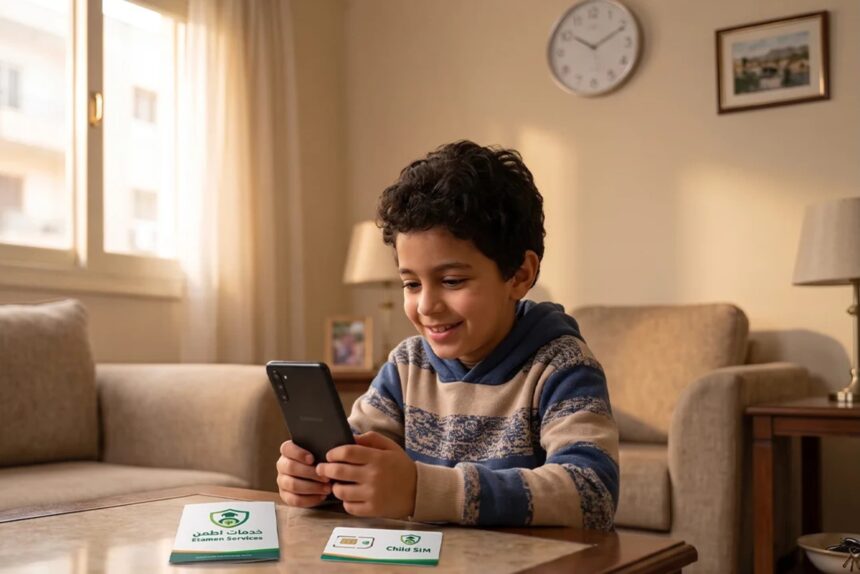
The Egyptian government has introduced two new child-focused mobile SIM services aimed at making internet access significantly safer for children. This marks another milestone in the country’s growing digital safety agenda.
Launched by the Ministry of Communications and Information Technology in partnership with the National Telecom Regulatory Authority (NTRA), the new services, Etmaen and Etmaen Ala El Akher, provide built-in online protection that helps shield children from harmful, age-inappropriate, and potentially dangerous digital content.
By embedding these safeguards directly into mobile network services, the initiative eliminates the need for parents to install additional applications or navigate complex parental control settings.
It offers families a simple and accessible way to promote safer internet use while ensuring children continue to benefit from the educational and developmental opportunities the digital world provides.
A National Push to Strengthen Child Online Safety
The new services were officially unveiled during a ceremony attended by Egypt’s Minister of Communications and Information Technology, Raafat Hendy, alongside senior officials from the National Telecom Regulatory Authority and representatives of the country’s leading telecommunications operators.
Also in attendance are Orange Egypt, e& Egypt, Telecom Egypt, and Vodafone Egypt. Technology firms Kidzonet and Cyshield as well participated in the launch, highlighting the collaborative approach adopted by both the public and private sectors.
The initiative aligns with directives from Egypt’s political leadership to strengthen child protection in the digital space as internet usage continues to expand across the country.
Rather than relying solely on public awareness campaigns to educate parents and children about online risks, the government is introducing practical, network-level solutions that make online safety more accessible for families.
The services are designed to reduce children’s exposure to inappropriate content while encouraging responsible internet use in an increasingly connected society.
Two Protection Levels Designed for Different Family Needs
The newly introduced services offer two levels of digital protection, allowing parents to choose the option that best suits their children’s online activities and age.
The first service, Etmaen, automatically blocks access to websites containing harmful or age-inappropriate material once it is activated on a child’s SIM card.
It also enables safe browsing features and activates Safe Search on major search engines, helping prevent explicit content from appearing in search results.
Beyond content filtering, the service strengthens cybersecurity by blocking websites associated with malware, viruses, phishing attempts, and other online threats that could compromise children’s devices or personal information.
For parents seeking even stronger controls, the second service, Etmaen Ala El Akher, includes every protection available under Etmaen while adding restrictions on social media websites and applications.
This additional layer is intended for families who prefer to limit children’s exposure to social networking platforms, helping reduce risks associated with cyberbullying, online predators, misinformation, excessive screen time, and other challenges linked to social media use.
Importantly, both services are designed to work without requiring parents to perform technical configurations or install third-party software, making them accessible even to users with limited digital literacy.
Easy Activation Through Egypt’s Mobile Operators
One of the key strengths of the initiative is its simplicity. Parents who own their children’s SIM cards can subscribe to either service through the retail outlets or official mobile applications of Egypt’s four mobile network operators.
This nationwide availability ensures that families across the country can easily activate the protections regardless of their telecom provider.
The content filtering standards implemented under the services are based on internationally recognised child online protection guidelines developed by the International Telecommunication Union (ITU).
By adopting globally accepted standards, Egypt aims to provide a consistent and reliable framework for safeguarding children while maintaining access to legitimate educational and informational resources available online.
Why This Matters: Safer Digital Ecosystem for Egyptian Families
The launch reflects a broader shift in how governments and telecommunications companies approach online safety.
As digital services become increasingly central to education, communication, and everyday life, telecom operators are expanding their role beyond providing connectivity to delivering services that promote digital wellbeing and consumer protection.
For Egypt, the Child SIM initiative represents an important step toward building a safer digital ecosystem where children can confidently explore educational opportunities online while parents gain greater peace of mind.
The collaboration between government institutions, telecom operators, and cybersecurity companies demonstrates how shared responsibility can be leveraged to address emerging digital risks.
As child online protection becomes an increasingly important policy priority around the world, Egypt’s approach could serve as a model for other countries seeking practical, easy-to-use solutions that integrate digital safety directly into mobile services.
By combining accessibility, international best practices, and industry collaboration, the initiative reinforces the country’s commitment to creating a more secure and responsible digital future for its youngest internet users.
Talking Points
Egypt’s Child SIM initiative is a pragmatic and forward-looking policy that shifts child online protection from being solely a parental responsibility to a shared responsibility between government, telecom operators, and technology providers.
By embedding safety features directly into mobile networks, the country lowers the technical barriers that often prevent parents from using digital safeguards.
However, the initiative is not a complete solution. While blocking harmful content and restricting social media can reduce children’s exposure to online risks, determined users can still bypass network-level controls through VPNs or alternative internet connections.
There is also the delicate challenge of balancing child protection with digital rights, ensuring content filtering remains transparent and does not evolve into broader internet censorship. Ultimately, technology alone cannot replace digital literacy, parental engagement, and responsible online behaviour.
If complemented by continuous digital education, transparent oversight, and regular updates to filtering standards, Egypt’s approach could become a practical model for other countries seeking to create a safer online environment for children without unnecessarily restricting access to the educational opportunities the internet offers.
____________________________
Bookmark Techparley.com for the most insightful technology news from the African continent.
Follow us on X/Twitter @Techparleynews, on Facebook at Techparley Africa, on LinkedIn at Techparley Africa, or on Instagram at Techparleynews