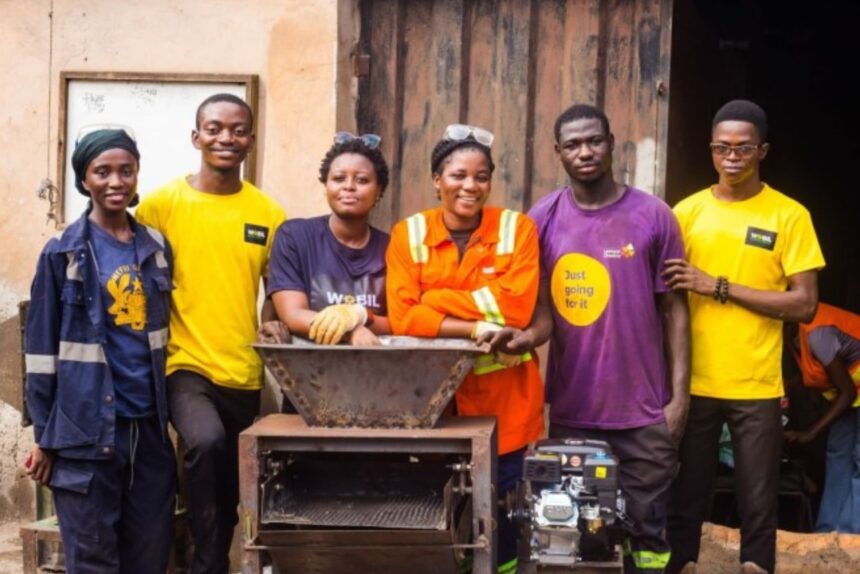
A student-founded Ghanaian climate-smart agri-tech startup, Wobil Technologies, is using locally manufactured, hybrid solar-powered agricultural machinery to tackle one of the persistent challenges facing smallholder rice farmers, inefficient and expensive post-harvest processing.
Founded by university students Erica Appiah and John Wobil in 2019, the startup has developed a patent-pending solar-powered rice thresher, alongside a grain cleaner and winnower designed for African farming conditions.
Wobil says its machinery can reduce energy costs by more than 70 per cent compared with conventional diesel-powered threshers while helping farmers minimise post-harvest losses and improve grain quality.
Since 2021, the company says it has served 900 smallholder farmers, processed 1,000 metric tonnes of rice and generated an additional GHS4.7 million, approximately US$420,000, in farmer revenue.
What is Wobil Technologies?
Wobil Technologies is a Ghanaian agricultural technology company focused on developing machinery that makes rice farming and post-harvest processing more efficient and affordable.
The company was founded in 2019 by Erica Appiah and John Wobil while they were undergraduate students at Kwame Nkrumah University of Science and Technology.
What began as a community-oriented project quickly evolved into a commercial opportunity after farmers expressed immediate interest in a prototype the students demonstrated on a farm in Adansi Asarekrom.
“We built a wooden, petrol-powered engine and took it to a farm in Adansi Asarekrom to demonstrate it,” Appiah said. “When we switched it on, farmers working nearby immediately asked us to bring it to their own fields to thresh their rice, and they were willing to pay for it on the spot.”
Wobil was subsequently registered in September 2021 and has since developed renewable-energy-powered agricultural machinery.
The problem Wobil is trying to solve
At the centre of Wobil’s business is the challenge of post-harvest losses among smallholder rice farmers. After harvesting, rice must be threshed, cleaned and processed before it can reach consumers, but many farmers still rely on manual and physically demanding methods.
Research conducted by Wobil in 2021 found that farmers across Ghana and other parts of Africa could lose up to 46 per cent of their harvest because of manual or delayed threshing, compounded by poor grain quality.
The problem is particularly significant among Ghanaian farmers, whose average age is estimated at between 55 and 60 years.
Many depend on their children to undertake physically demanding agricultural activities because hiring external labour can be prohibitively expensive.
Wobil is therefore targeting a problem that affects both farm productivity and household income.
Solar-powered machinery for African farming
Wobil has moved from its early petrol-powered prototype and diesel-powered machinery into renewable-energy technology.
Its flagship product is a patent-pending Multi-Stage Hybrid Solar-Powered Rice Thresher, designed specifically around the conditions of African agriculture.
The company has also developed a solar-powered grain cleaner and winnower to improve the quality of processed rice.
According to Appiah, the machines “cut post-harvest losses, improve grain quality, and reduce energy costs by over 70 per cent compared to conventional diesel-powered threshers.”
The company’s grain cleaner and winnower have also received independent validation from CSIR-CRI under Ghana’s Ministry of Food and Agriculture, which reportedly confirmed a 98 per cent cleaning efficiency.
By combining agricultural machinery with renewable energy, Wobil is seeking to make mechanised farming more affordable while reducing dependence on fossil-fuel-powered equipment.
Making expensive farm machinery accessible
The affordability of agricultural machinery is another challenge Wobil is attempting to address. Although imported threshers are available to farmers, the company says some can cost as much as US$10,000, placing them beyond the reach of many smallholder farmers.
Rather than requiring farmers to purchase expensive equipment outright, Wobil has adopted pay-per-use and leasing models that allow farmers to access machinery according to their needs.
The approach effectively turns the machinery into a service rather than an asset that every farmer must own.
Wobil has also established a community-based service and maintenance network intended to keep its equipment operational closer to farming communities.
Since 2021, the startup says it has served 900 smallholder farmers, processed 1,000 metric tonnes of rice and generated an additional GHS4.7 million, or about US$420,000, in farmer revenue.
Funding, jobs and the road to West Africa
Despite its progress, Wobil has largely built its business without venture capital, relying primarily on grant funding.
One of its notable supporters has been the Standard Chartered Foundation’s Women in Tech Accelerator, implemented in Ghana by the Ghana Climate Innovation Center with support from Village Capital.
Beyond financing, the programme provided business mentorship, fundraising-readiness training and structured accountability.
“We were paired with a portfolio manager who worked closely with us throughout, offering tailored guidance and honest feedback on our business,” Appiah said.
Wobil says it has created 58 direct jobs, while women account for 36 per cent of its paying customers, with the company targeting 50 per cent by 2028.
Currently operating in Ghana’s Ashanti and Volta regions, the startup plans to expand into Bono, Northern and Western regions before entering wider West African markets, including Côte d’Ivoire and Nigeria.
Building a woman-led future for African agri-tech
For Appiah, Wobil’s journey also represents a broader effort to increase women’s participation in engineering, agriculture and technology.
As the only woman on the founding team during the company’s early years, she said building the business came with both internal and external challenges, including financial pressure and expectations that she should pursue a conventional job.
Nevertheless, direct interaction with farmers has remained a major source of motivation.
“Watching someone use our machine for the first time, seeing the relief on their face, is what reminds me why we started,” she said.
Appiah also said farmers are sometimes surprised to learn that a woman helped build the machine they are using, but that surprise often becomes encouragement.
For Wobil, the ambition therefore extends beyond agricultural mechanisation: it is also about demonstrating that African women can build, own and lead technology companies solving practical problems in their communities.
_________________________
Bookmark Techparley.com for the most insightful technology news from the African continent.
Follow us on X/Twitter @Techparleynews, on Facebook at Techparley Africa, on LinkedIn at Techparley Africa, or on Instagram at Techparleynews