



Cybersecurity discussions across Africa have long been dominated by incidents, data breaches, fraud cases, and system compromises.
Yet, beneath these headlines lies a deeper structural issue, including limited access to the tools required to investigate, understand, and prevent such threats at scale.
For Suleiman Farouk, founder and CEO of Sulfman Consulting Limited, that gap is becoming increasingly difficult to ignore.
“Cybersecurity is a shared responsibility,” he said. “But one of the problems we still have is intelligence sharing and access to the right tools.”
The hidden gap in Africa’s cybersecurity ecosystem
Since its founding in 2015, Sulfman Consulting Limited has built a reputation providing penetration testing, cyber threat intelligence, and cybersecurity training to organisations across sectors.
Through this work, the company identified a recurring constraint, that while cyber risks were rising, many organisations lacked affordable and accessible digital intelligence tools to investigate threats, conduct due diligence, or monitor their online exposure.
This challenge is becoming more acute as Africa’s digital economy expands. Businesses increasingly rely on digital footprints, spanning social media, corporate databases, and online infrastructure to assess risk, verify identities, and make strategic decisions.
However, the tools required to extract and analyse this information are often expensive, technically complex, or designed primarily for law enforcement agencies in developed markets.
What you need to know
To address this gap, Sulfman Consulting Limited has developed Eagle Watch, an AI-powered digital investigation platform built on open-source intelligence (OSINT).
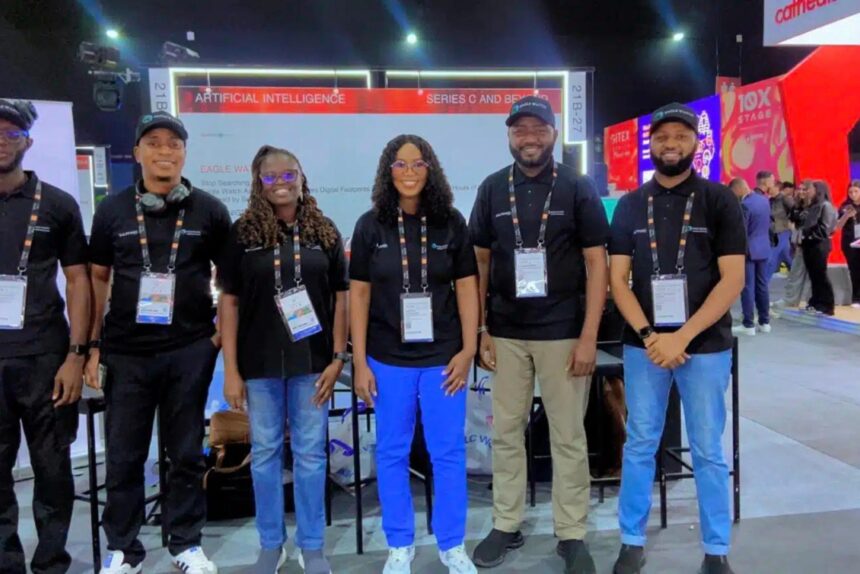
Launched at GITEX Nigeria in September 2025, the platform is designed to enable organisations and individuals to analyse digital footprints using publicly available data.
Eagle Watch can be deployed for a range of use cases, including pre-employment screening, executive due diligence, fraud detection, and digital asset monitoring.
“If you want to know more about an individual, a company, or even your own digital assets, Eagle Watch gives you that ability through a simple search,” Farouk explained.
At its core, the platform is built around accessibility. Unlike traditional intelligence tools, Eagle Watch operates on a token-based pricing model, allowing users to pay per search rather than commit to high upfront costs.
Balancing intelligence with ethics and privacy
As AI-powered investigation tools gain traction globally, they have also raised concerns around surveillance, data privacy, and misuse.
Sulfman Consulting Limited maintains that Eagle Watch is strictly limited to analysing publicly available information and does not engage in hacking or intrusive surveillance activities.
The platform aggregates and interprets open-source data to identify patterns, relationships, and potential risk indicators, positioning itself as a compliance-friendly solution for businesses.
This distinction is critical in a regulatory environment where data protection frameworks are still evolving across many African markets.
Tackling fragmentation in cyber intelligence sharing
Beyond tooling, Farouk points to another systemic challenge, which is the lack of structured intelligence sharing across organisations.
In many cases, companies investigate cyber incidents internally but fail to share insights with the broader ecosystem, limiting collective learning and leaving other organisations exposed to similar threats.
Eagle Watch, he argues, could play a role in bridging this gap by enabling faster, more accessible intelligence gathering across industries.
Since its debut at GITEX Nigeria, Eagle Watch has been showcased at international events, including GITEX Africa in Morocco, where it attracted attention from global stakeholders.
Precious Umunnakwe, Chief Revenue Officer at Sulfman, noted that early users were surprised by the platform’s capabilities beyond local datasets.
The company has since entered partnership discussions with organisations seeking to deploy the platform for enterprise intelligence, financial investigations, and compliance checks.
Talking Points
At Techparley, we see the launch of Eagle Watch by Sulfman Consulting Limited as a timely intervention in Africa’s cybersecurity landscape, where access to digital investigation tools has remained limited despite rising threats.
It is particularly notable that the platform focuses on open-source intelligence, making it possible for organisations to conduct due diligence, risk assessments, and digital investigations without relying on expensive, foreign-built systems.
This approach directly addresses one of the biggest gaps in the ecosystem: affordability and accessibility, which have historically restricted advanced cybersecurity capabilities to a small number of institutions.
The token-based pricing model also stands out as a practical innovation, lowering entry barriers for SMEs and making digital intelligence tools more usable across different business sizes.
As Africa’s digital economy expands, we see solutions like this playing a critical role in building locally relevant cybersecurity infrastructure that is both scalable and accessible.
——————-
Bookmark Techparley.com for the most insightful technology news from the African continent.
Follow us on Twitter @Techparleynews, on Facebook at Techparley Africa, on LinkedIn at Techparley Africa, or on Instagram at Techparleynews.