

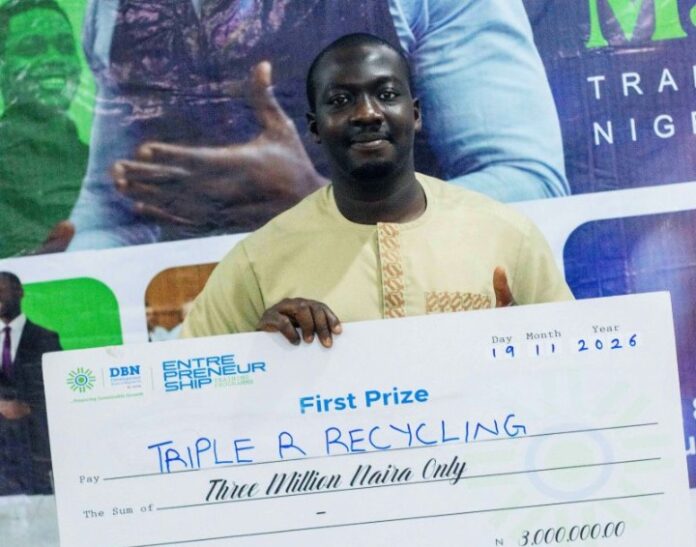
Abuja-based Triple R Recycling Limited has secured a ₦3 million grant after emerging first in the Development Bank of Nigeria (DBN) Entrepreneurship Grant Programme, adding to its growing list of recognitions for tackling plastic pollution through recycling and sustainable innovation.
Announced on his LinkedIn page, Triple R Recycling’s founder Abdullahi Suleiman Ezhin notes that the achievement comes just two weeks after the company won the DBN National Sustainability Award, marking two major victories for the climate-focused startup.
Triple R Recycling has recovered over one million kilograms of post-consumer plastics since 2023, established 16 collection points across the Federal Capital Territory (FCT), and created more than 100 direct and indirect jobs.
Speaking exclusively to Techparley Africa, Ezhin said the recognitions validated the company’s work, adding that they demonstrate that “recovering plastic waste can be a serious business.”
DBN Recognitions Strengthen Triple R Recycling’s Credibility
The latest ₦3 million award followed a competitive pitching process involving other businesses under the DBN Entrepreneurship Grant Programme. According to Ezhin, the company also emerged first nationally in the DBN National Sustainability Award after being shortlisted to represent the North Central region.
The founder believes Triple R Recycling’s operational achievements and measurable environmental impact distinguished it from other competitors.
Since its establishment in 2023, the company has recovered more than one million kilograms of post-consumer plastics and built an organised collection network across the FCT.
It has also created over 15 direct jobs and more than 100 indirect employment opportunities. Ezhin explained that the recognition provides the company with greater credibility among potential partners and funders, reinforcing its position as an emerging player in Nigeria’s circular economy.
How Triple R Recycling Turns Plastic Waste into Economic Opportunities
Triple R Recycling operates a cash-for-waste model that encourages households and waste collectors to exchange plastic waste for money. The company currently operates 16 collection points across the FCT, while residents can also schedule doorstep pickups through its website.
After collection, the plastics are sorted, weighed and compressed into bales before being supplied to industrial recyclers.
Ezhin identified Alef among the company’s buyers, explaining that such recyclers supply recycled plastic materials to manufacturers, including companies like Nestlé.
Beyond conventional plastic recovery, Triple R Recycling is developing interlocking paving stones from discarded plastics and sand. The innovation targets hard-to-recycle materials that might otherwise end up in landfills, drainage systems or be burned.
The company is also digitising its collection, payment and record-keeping processes to improve operational efficiency.
DBN Grant to Double Plastic Waste Collection Capacity
Ezhin disclosed that the newly secured ₦3 million grant will support two major priorities: expanding plastic waste collection and increasing the production of recycled plastic interlocking pavers.
The company intends to double its monthly plastic waste collection capacity from 15 tonnes to 30 tonnes. Achieving this target will require expanding its collection network, increasing payments to waste collectors and maintaining sufficient working capital to purchase recyclable materials consistently.
The second priority is scaling up interlocking paver production to accommodate more hard-to-recycle plastics. According to the founder, the investment is expected to generate more income for waste collectors, create additional jobs and strengthen the company’s revenue through paver sales.
He explained that the objective is to recover more plastic waste and transform it into useful products, ensuring that the funding delivers both environmental and commercial value.
Tackling Operational Challenges Through Infrastructure and Partnerships
Despite its growth, Triple R Recycling faces operational challenges, particularly unreliable electricity, limited working capital and inadequate organised waste collection infrastructure.
Ezhin revealed that the high cost of running diesel generators previously resulted in significant financial losses for the company.
To address the electricity challenge, the startup worked with the Abuja Electricity Distribution Company (AEDC) and secured a 500 kVA transformer for its operating area, enabling it to move from diesel-powered operations to grid electricity.
The company also maintains partnerships with industrial recyclers such as Alef and holds corporate membership of the Waste Pickers Association of Nigeria.
It participated in the unveiling of Nigeria’s Plastic Waste Control Regulations 2026 alongside the National Environmental Standards and Regulations Enforcement Agency (NESREA) and the Federal Ministry of Environment.
It was also among 20 innovators selected for a UNDP-GEF Small Grants Programme workshop.
From DRIVE100 Fellowship to Multiple Grant Wins
Triple R Recycling’s latest achievement builds on a series of funding and development milestones previously reported by Techparley Africa. The company received approximately $500 from the Global Recycling Foundation to advance its plastic-based interlocking paving stone project.
It subsequently secured a ₦1 million NIYA Startup 2.0 grant and a ₦2 million grant from Digital Peers International, supported by the United Nations Development Programme (UNDP) Small Grants Programme.
The startup was also one of the 100 selected fellows spotlighted during Techparley Africa’s 2025 DRIVE100 Accelerator Programme, which provided a platform for emerging African entrepreneurs and innovators.
In an earlier interview with Techparley Africa, Ezhin credited the accelerator with providing mentorship, leadership development, strategic guidance and access to innovation networks that strengthened the company’s business strategy.
Looking ahead, Triple R Recycling plans to increase its monthly waste recovery capacity to 30 tonnes, expand interlocking paver production and complete its digital platform.
Within the next three to five years, Ezhin hopes to establish the company as a leading recycling business in the FCT, with a model that can be replicated across Nigeria and other African countries.
Beyond commercial expansion, he envisions cleaner communities, reduced flooding caused by blocked drainage systems and more sustainable income opportunities for waste collectors. As he puts it, the company’s ambition extends beyond recycling:
“The impact I want is cleaner communities, less flooding from blocked drains, and steady incomes for collectors,” Ezhin said.
__________________________________
Bookmark Techparley.com for the most insightful technology news from the African continent.
Follow us on X/Twitter @Techparleynews, on Facebook at Techparley Africa, on LinkedIn at Techparley Africa, or on Instagram at Techparleynews

