



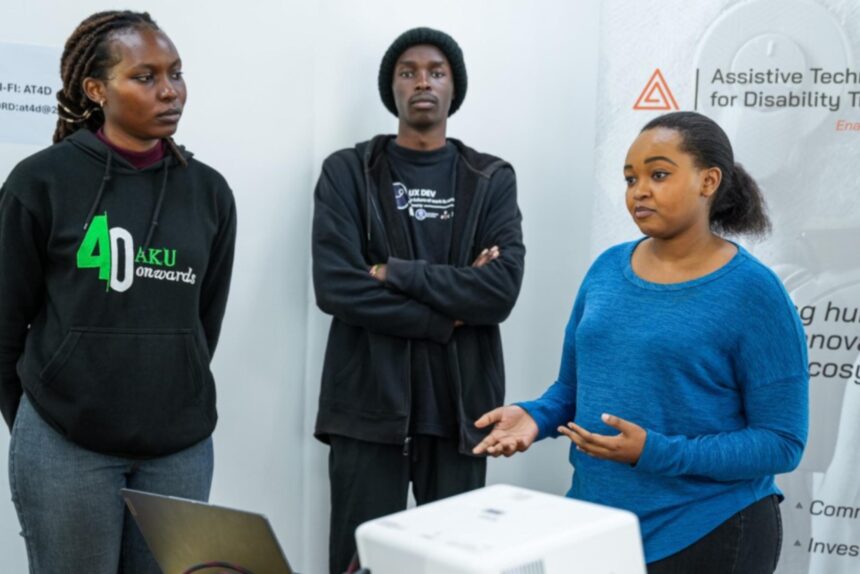
Innovate Now, a Kenya-based accelerator focused on assistive technologies, has unveiled its largest cohort to date, signalling a deepening commitment to building products around the lived experiences of persons with disabilities.
The programme, implemented by the Assistive Technologies for Disability Trust (AT4D), has selected 19 startups spanning speech therapy, mobility, inclusive education and caregiver support, sectors where demand is rising rapidly but locally adapted solutions remain limited.
Across Africa, an estimated 200 million people require at least one assistive product. Yet access remains constrained by high costs, often driven by reliance on imported devices and by designs that fail to account for local infrastructure, cultural contexts and maintenance realities.
“At Innovate Now, building with persons with disabilities at the centre is not optional, it is essential,” said Bernard Chiira, founder of AT4D. “It ensures the solutions are not only innovative, but truly relevant, accessible, and affordable.”
What You Need to Know
At the core of Innovate Now’s approach is its “Live Labs” model, which embeds persons with disabilities directly into early-stage product development. Users are involved in testing prototypes, identifying usability challenges and shaping how solutions evolve before reaching the market.
Programme organisers argue that this intervention addresses a persistent flaw in the sector, where many technologies are historically developed with limited input from those who rely on them.
For participants, the shift is tangible. Mary, a caregiver involved in product testing, described the process as a departure from traditional development cycles.
Hackathon Fuels AI-driven Innovation
The latest cohort was partly shaped by a 72-hour “AI for Accessibility” hackathon held from 5 to 7 March, which brought together developers, university students and persons with disabilities to co-create solutions from the ground up.
Fifteen projects emerged from the event, with ten progressing into incubation. These were joined by nine additional startups selected through an open call, forming the 19-member cohort.
Among the standout ventures is Chacha, an AI-powered platform developed during the hackathon to support children with speech impairments through real-time feedback and guided exercises.
Chacha targets a longstanding shortage of speech and language therapy services across the continent, particularly in early childhood care.
Its founder, Peninah Gituku, said the co-creation process fundamentally reshaped the product’s design.
The platform is aimed at children aged 0 to 8 with mild speech impairments. It combines pronunciation feedback with exercises informed by both caregivers and professional therapists, with a focus on usability in home settings where formal therapy is often inaccessible or unaffordable.
From Incubation to Impact
The selected startups will now enter an eight-month incubation phase, during which they will refine their products through mentorship, coaching and continued user testing. The programme is being delivered in partnership with Kilimanjaro Blind Trust Africa.
Since its launch in 2019, Innovate Now reports supporting 88 assistive technology ventures and engaging more than 200 founders across 10 cohorts. Collectively, these startups have reached over 40,000 users.
Roughly 40 per cent of supported ventures have brought products to market, while 38 per cent have secured funding through grants and awards, an indication, organisers say, that investor interest in inclusive technology is beginning to build.
What This Means
The expansion of Innovate Now’s cohort comes at a time when assistive technology is gaining visibility as both a social and economic priority across Africa.
As governments and development partners increasingly emphasise inclusion, accelerators such as Innovate Now are positioning themselves as critical pipelines for locally grounded innovation, bridging the gap between unmet need and scalable solutions.
For Chiira and his team, the objective is clear: ensure that the next generation of assistive technologies is not only built in Africa, but built with those who need them most.
Talking Points
It is encouraging to see Innovate Now expanding its cohort, especially at a time when access to assistive technology remains a major gap across Africa.
What stands out most is its “Live Labs” approach, which brings persons with disabilities directly into the product design process. This is a practical shift from theory to reality, ensuring solutions are not just innovative but actually usable in everyday African contexts.
At Techparley, we see this as a critical step in addressing one of the sector’s biggest challenges, the disconnect between product design and real user needs, particularly in markets where infrastructure, affordability and maintenance are key constraints.
The focus on sectors such as speech therapy, mobility and inclusive education is also significant. Solutions like Chacha show how AI can be applied in a targeted way to solve real service gaps, especially in early childhood development where access to specialists is limited.
The hackathon-to-incubation pipeline is another strong point. It creates a clear pathway from idea to execution, helping founders move beyond concepts into scalable solutions.
However, scaling these innovations will depend on more than product development. Adoption will hinge on affordability, user education and how well these solutions integrate into existing systems such as schools, healthcare providers and community networks.
As Innovate Now grows, there is a clear opportunity to deepen partnerships with governments, NGOs and private sector players to accelerate distribution and impact.
With the right support, this model could help unlock a new wave of inclusive innovation, one that ensures assistive technology is not just available, but accessible to those who need it most across the continent.
——————-
Bookmark Techparley.com for the most insightful technology news from the African continent.
Follow us on Twitter @Techparleynews, on Facebook at Techparley Africa, on LinkedIn at Techparley Africa, or on Instagram at Techparleynews.