


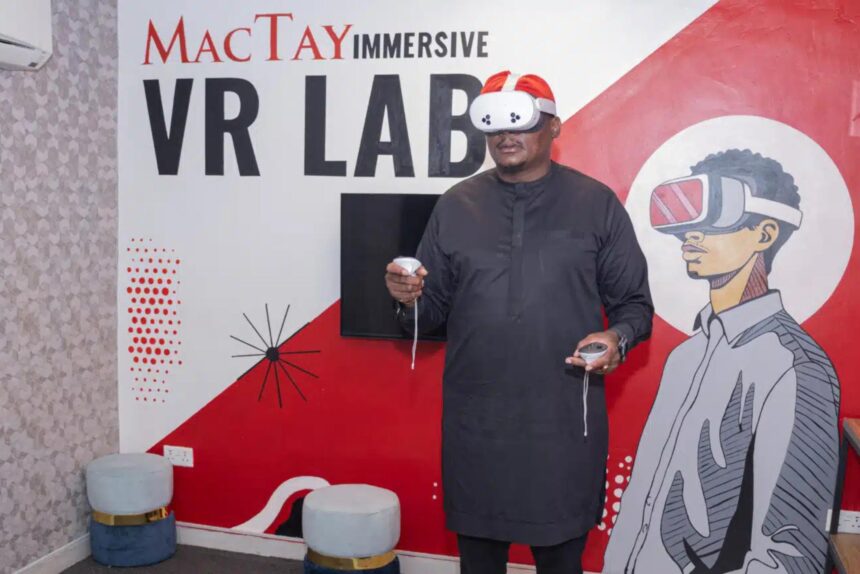
More than 300 emergency service professionals in Lagos have been trained using virtual reality (VR) technology, marking a shift in how high-risk response skills are developed in one of Africa’s largest cities.
Inside the simulations, trainees are placed on a digital replica of the Lekki-Ikoyi Link Bridge, responding to life-threatening accidents and making real-time decisions, an experience designed to mirror scenarios they would otherwise encounter only in the field.
The programme, led by MacTay under its Better Lagos Initiative, reflects a growing move towards immersive, technology-driven training methods that prioritise realism without exposing participants to actual danger.
For Tunde Rotimi, MacTay’s Head of Strategy and Innovation, the core advantage of VR lies in its ability to replicate complex emergencies at scale.
“It is very challenging to duplicate a high-risk environment,” he says. “We modelled the Lekki-Ikoyi link bridge and trained over 300 people there. You can’t have more than seven participants on that bridge at once; imagine training everyone there.”
What you need to know
The VR system places trainees at the scene of a road traffic accident, where they must assess victims, check vital signs using haptic feedback, administer first aid and coordinate evacuation efforts.
Guided prompts simulate the pressure of real emergencies, requiring participants to make quick decisions while navigating evolving situations.
According to Rotimi, this approach helps build “muscle memory”, a critical factor in emergency response where hesitation or error can have life-threatening consequences.
The training has been deployed in collaboration with the Lagos State Ambulance Service (LASAMBUS), integrating immersive learning into frontline healthcare preparedness.
From STEM classrooms to emergency response
Interestingly, the technology was not originally developed for emergency services. MacTay initially built its VR tools to enhance STEM education, enabling students to visualise complex concepts in three dimensions.
In early use cases, students could explore human anatomy from within or interact with microchips in ways that traditional textbooks could not replicate.
That direction shifted following engagements with the Lagos State Ministry of Health, where the potential for applying immersive learning to high-stakes medical and emergency scenarios became clear.
The VR initiative is part of a wider transformation within MacTay itself. Founded more than 40 years ago as a human resources consulting firm, the company is repositioning as a technology-driven organisation.
Central to this evolution is the company’s focus on artificial intelligence, particularly what it describes as “precision AI solutions” aimed at augmenting human workers or automating specific workflows rather than replacing jobs outright.
Aligning with global trends
While VR is still often associated with gaming, its application in professional training is well established globally.
Healthcare institutions such as Johns Hopkins Medicine and the Mayo Clinic use immersive simulations to train surgeons and emergency responders.
Construction firms deploy VR for safety drills before workers enter hazardous sites, while military organisations, including the US Army, rely on simulation to prepare personnel for high-pressure environments.
MacTay’s approach aligns with this broader shift, one where experience can be simulated, repeated and refined without real-world consequences.
Adoption challenges and local momentum
In Nigeria, however, VR adoption has remained limited despite early experimentation between 2016 and 2019.
Startups such as Imisi 3D and StanLab have explored immersive learning and virtual laboratories, but the technology has yet to achieve widespread deployment, largely due to cost, infrastructure constraints and limited awareness.
MacTay’s collaboration with the Lagos State government could help change that trajectory, particularly as the company explores expanding VR into public education.
Discussions are already underway with the Lagos State Ministry of Education to introduce VR into basic education, with potential expansion into higher institutions to enhance STEM learning.
For MacTay, the long-term ambition extends beyond training emergency responders. The company is positioning VR as a scalable tool for capacity building, one that enables faster, safer and more cost-effective learning across sectors.
Talking Points
It is notable that MacTay is applying virtual reality to emergency response training, addressing a long-standing challenge in preparing first responders without exposing them to real-world risk.
By simulating high-pressure scenarios such as accidents on the Lekki-Ikoyi Link Bridge, the programme creates a practical training environment where responders can build experience through repetition, something that is difficult to achieve with traditional methods.
At Techparley, we see this as a strong example of how immersive technology can move beyond theory and deliver real-world impact, particularly in public sector systems where preparedness is critical.
The ability to train over 300 personnel in a controlled, scalable environment highlights one of VR’s biggest advantages, removing the logistical and safety constraints that limit physical simulations.
It is also significant that this solution evolved from a STEM education tool into a healthcare application. This kind of adaptability reflects how emerging technologies can be repurposed to solve more urgent, high-impact problems.
However, broader adoption will depend on key factors such as cost, infrastructure and institutional buy-in. VR has shown promise in Nigeria before, but scaling it beyond pilot programmes remains a challenge.
As MacTay expands its work with the Lagos State government, there is a clear opportunity to deepen integration across healthcare and education systems, where immersive training could drive measurable improvements in outcomes.
——————-
Bookmark Techparley.com for the most insightful technology news from the African continent.
Follow us on Twitter @Techparleynews, on Facebook at Techparley Africa, on LinkedIn at Techparley Africa, or on Instagram at Techparleynews.