



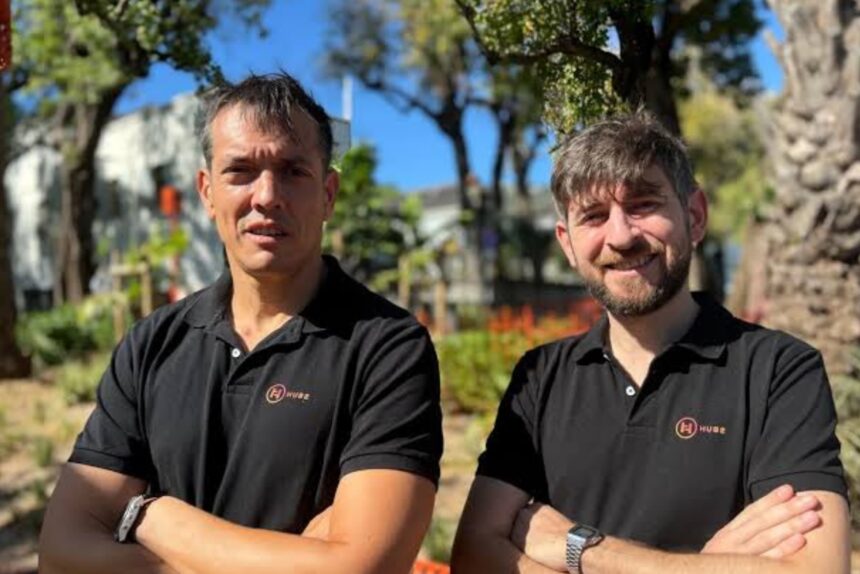
Hub2 is placing itself as the invisible infrastructure powering seamless transactions across Francophone Africa to unify the continent’s fractured payment ecosystem.
Active in 12 countries and backed by an €8 million Series A raised in late 2024, the fintech is tackling one of the continent’s most persistent challenges, disconnected payment systems.
By offering a single API that links mobile money platforms, banks, and financial institutions, Hub2 is enabling businesses to operate across borders without the burden of multiple technical integrations.
“Think of us as a network of pipes used to transport water or gas; we build the network of ‘pipes’ that circulate money,” said co-CEO Jean-Rémi Kouchakji, while underscoring the company’s ambition to become the backbone of Africa’s digital payments landscape.
What Hub2 is and What It Does
Founded in 2019, Hub2 emerged from a clear observation: Africa’s fintech ecosystem was growing rapidly, but its infrastructure remained deeply fragmented.
Fintech startups, digital platforms, and financial institutions seeking to operate across multiple countries were forced to build separate integrations for each market, an inefficient and costly process.
To address this, Hub2 developed a unified API infrastructure that connects various payment systems into a single network.
“The company was born from the observation that fintechs and digital platforms had to multiply technical integrations to operate across several markets. We therefore designed a unique API infrastructure to orchestrate different payment rails across multiple countries,” Kouchakji explained.
By acting as an “orchestrator,” Hub2 enables neobanks, e-commerce platforms, corporates, and money transfer operators to deliver seamless payment services to customers, regardless of geographic boundaries.
In essence, it simplifies complexity by allowing businesses to plug into one system instead of many.
What Has Hub2 Changed?
Before Hub2’s entry, Africa’s payment landscape, particularly in Francophone regions, was characterized by siloed systems and limited interoperability. Mobile money adoption was rising quickly, but platforms operated in isolation, creating barriers for cross-border transactions and regional expansion.
Hub2 has fundamentally shifted this dynamic by introducing interoperability into the ecosystem. Instead of requiring companies to integrate separately with each mobile money operator or banking system, Hub2 provides a unified “piping” network that connects them all.
“Africa doesn’t have a digital adoption problem; it has an interoperable infrastructure problem,” Kouchakji noted. “For a company, operating in 10 countries meant 10 different integrations. Hub2 fills this void by offering unified ‘piping’ where the market is still fragmented.”
The impact has been significant as Hub2 reports a transaction success rate exceeding 98 percent, far above the market average, which can fall to as low as 50 percent, while also driving substantial growth in transaction volumes.
The Partnership and Market Capacity
A major milestone in Hub2’s growth is its strategic partnership with Ecobank, one of Africa’s leading banking groups.
Described by Kouchakji as an “historic milestone,” the collaboration represents more than a typical commercial agreement, it is a structural integration of banking and fintech capabilities.
“By connecting our 200 million mobile wallets to Ecobank’s digital platform, we are creating a financial highway across 32 markets,” he said. “For a merchant, it means they can now operate regionally with the same ease as they do locally.”
This partnership bridges the gap between mobile money ecosystems and traditional banking infrastructure, combining regulatory strength with technological agility. Ecobank contributes licenses, regulatory capital, and institutional stability, while Hub2 delivers innovation, speed, and user-focused design.
The result is a powerful platform capable of supporting large-scale financial flows across the continent, including international remittances, for which Hub2 has recently secured a key licence.
Why This Matters
Hub2’s innovation goes beyond technical convenience, it addresses a structural barrier to Africa’s economic integration. Fragmented payment systems have long hindered trade, limited financial inclusion, and increased the cost of doing business across borders.
By enabling interoperability, Hub2 is helping to unlock regional commerce and digital financial inclusion. Businesses can expand more easily, consumers can transact more reliably, and financial services can reach underserved populations.
“Financial inclusion is a collective fight against cash and exclusion. It relies on connectivity,” Kouchakji said. “We must work hand-in-hand: banks, regulators, governing bodies, local authorities and fintechs.”
The company’s approach also signals a maturing fintech ecosystem, where startups increasingly align with regulatory frameworks to build sustainable, scalable solutions.
“To become a serious player, one must embrace regulation,” Kouchakji added, noting Hub2’s transition into a group of regulated entities.
How Hub2 is Making Money
Hub2 operates a scalable, partner-aligned revenue model built around transaction activity and infrastructure usage.
The company generates income primarily through commissions on transaction volumes processed on its network, ensuring that its growth is directly tied to the success of its partners.
In addition, Hub2 offers multi-country orchestration services, enabling businesses to manage payments across several markets through a single interface. It also provides value-added services such as integration support, compliance solutions, and settlement management.
“We favour a scalable model aligned with our partners’ growth,” Kouchakji said, highlighting the company’s focus on long-term ecosystem development rather than short-term gains.
Talking Points
What Hub2 is building is undeniably valuable, but it sits in a space where ambition often outruns structural reality. The company correctly identifies Africa’s core problem, not adoption, but interoperability, and its API-led “orchestration” model is a logical fix to fragmented payment rails.
However, positioning itself as the connective tissue of an entire region comes with heavy dependencies, regulatory fragmentation, uneven infrastructure maturity, and entrenched telecom-led mobile money monopolies that are not always incentivised to open up.
While its reported 98% success rate is impressive, such metrics in emerging markets can be difficult to independently verify at scale, especially across diverse jurisdictions.
The partnership with Ecobank is strategically sound, but also reveals a limitation, fintechs in Africa still need the balance sheets and licences of traditional banks to truly scale, raising questions about how much control Hub2 actually owns in the value chain.
Conclusively, Hub2 is solving a real and urgent problem, but its long-term defensibility will depend less on technology, which is replicable, and more on regulatory positioning, deep partnerships, and whether it can avoid becoming just another intermediary layer in an already complex financial stack.
____________________
Bookmark Techparley.com for the most insightful technology news from the African continent.
Follow us on X/Twitter @Techparleynews, on Facebook at Techparley Africa, on LinkedIn at Techparley Africa, or on Instagram at Techparleynews