



The promise of “physical AI” is a future where engineers can programme machines operating in the real world with ease and flexibility. That vision, however, remains out of reach. New York-based startup Antioch is positioning itself at the centre of this shift.
The startup bets on high-fidelity simulation to accelerate robotics development as industry grapples with data constraints.
Its goal is to tackle what the industry refers to as the “sim-to-real gap”, the challenge of ensuring that behaviours learned in virtual environments translate reliably into real-world performance.
“How can we do the best possible job reducing that gap, to make simulation feel just like the real world from the perspective of your autonomous system?” Antioch co-founder Harry Mellsop said.
To advance that ambition, the company has raised $8.5m in a seed funding round led by A* and Category Ventures, with participation from MaC Venture Capital, Abstract, Box Group and Icehouse Ventures. The round values Antioch at $60m.
What you should know
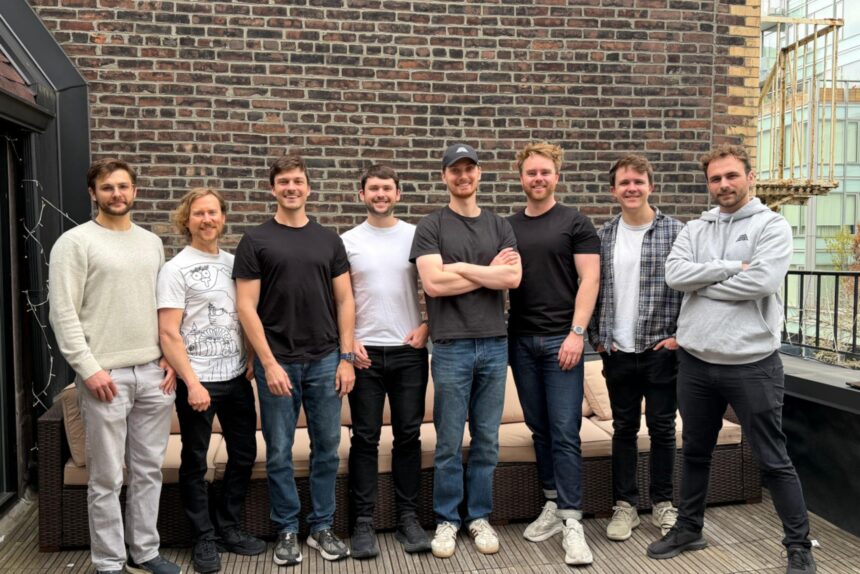
Founded in May last year, Antioch was established by a team with experience spanning startups and advanced AI research labs, including alumni from Meta Reality Labs and Google DeepMind.
The company is developing a platform that allows robotics engineers to create multiple digital instances of their hardware and connect them to simulated sensors that replicate real-world data inputs.
This enables developers to test edge cases, generate training data and run reinforcement learning models in a controlled environment, capabilities that would be prohibitively expensive or dangerous to replicate physically.
Antioch executives liken the platform to tools such as Cursor in software development, arguing that robotics needs a similar layer of accessible, developer-friendly infrastructure.
A growing need for simulation
The demand for such tools is increasing as industries invest more heavily in autonomy.
In the self-driving sector, for instance, companies like Waymo use advanced “world models” to simulate driving scenarios and test their systems before deploying them on real roads. This approach reduces the need for extensive real-world data collection, one of the most expensive aspects of scaling autonomous vehicles.
However, building and maintaining such simulation systems requires significant capital and expertise, resources that many smaller companies lack.
“The vast majority of the industry doesn’t use simulation whatsoever, and I think we’re now just really understanding clearly that we need to move faster,” Mellsop said.
High stakes, higher expectations
The challenge lies in fidelity. For simulation to be effective, virtual environments must accurately replicate real-world physics and sensor behaviour. Any mismatch can lead to failures when systems are deployed outside the lab.
To address this, Antioch builds on existing models from providers such as Nvidia and World Labs, layering domain-specific tools to make them usable for robotics developers.
Working with multiple customers also allows the company to refine its simulations using a broader range of data than any single robotics firm could generate independently.
The stakes are high. Unlike software errors, which are often contained within digital systems, failures in physical AI can have real-world consequences.
From startups to multinationals
While Antioch’s platform is aimed at startups, early interest has also come from large multinational companies investing heavily in robotics.
Its initial focus is on sensor and perception systems, which are critical for applications ranging from autonomous vehicles and drones to agricultural and construction machinery.
More ambitious visions, such as general-purpose robots capable of replicating human tasks remain further on the horizon.
Industry observers see simulation as a foundational layer for the future of physical AI.
Closing the loop
Antioch’s longer-term ambition is to enable a continuous feedback loop between simulation and real-world deployment, allowing systems to improve iteratively with each cycle..
Early experiments point in that direction. Researchers are already using simulation platforms to test AI-generated robot designs and benchmark models in controlled environments.
Despite growing momentum, significant challenges remain in closing the sim-to-real gap. If achieved, experts say the impact could be transformative. Developers would be able to generate vast amounts of training data virtually, accelerating innovation while reducing costs and risks.
For Antioch, the bet is that simulation will become a core layer of the physical AI stack, one that underpins the next generation of autonomous systems.
Whether the company can deliver on that promise will depend not just on technology, but on its ability to convince an industry still rooted in the physical world to embrace a more virtual approach to building it.
Talking Points
It is notable that Antioch is focusing on one of the most critical bottlenecks in physical AI, the lack of scalable, high-quality real-world data needed to train autonomous systems.
By positioning simulation as an alternative to expensive and impractical physical testing, the company is addressing a fundamental challenge that has slowed progress in robotics for years.
At Techparley, we see this as part of a broader shift towards software-defined development in industries that have traditionally relied on physical environments, particularly in robotics, autonomous vehicles and industrial automation.
The concept of closing the “sim-to-real gap” is central here. If simulation environments can accurately replicate real-world conditions, developers can train, test and iterate much faster without the risks associated with physical deployment.
This also has significant implications for startups. By lowering the cost of experimentation, platforms like Antioch could democratise access to robotics development, enabling smaller companies to compete with well-funded players.
As the sector evolves, there is a clear opportunity for platforms like Antioch to become part of the core infrastructure for physical AI, much like developer tools did during the rise of software and SaaS.
If successful, this approach could accelerate the development of autonomous systems across industries, from transport and logistics to agriculture and manufacturing, fundamentally changing how machines are built and trained.
——————-
Bookmark Techparley.com for the most insightful technology news from the African continent.
Follow us on Twitter @Techparleynews, on Facebook at Techparley Africa, on LinkedIn at Techparley Africa, or on Instagram at Techparleynews.