



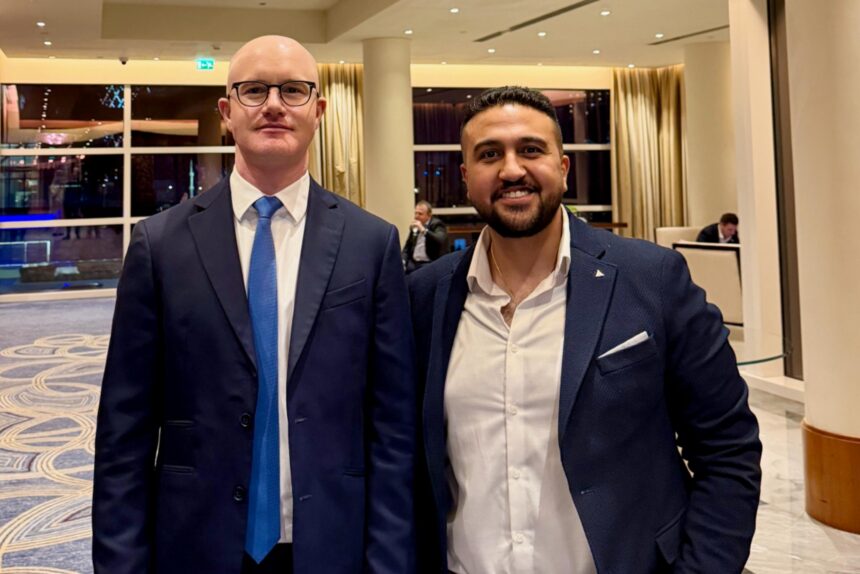
New York-based and Egyptian-founded crypto infrastructure startup, Kemet has entered a partnership with Coinbase, in a move aimed at simplifying institutional access to derivatives trading across multiple global markets.
The agreement will allow institutional clients to access Coinbase’s four trading venues, including Coinbase Exchange, Coinbase Derivatives Exchange, Coinbase International Exchange, and Deribit, through a single integrated platform powered by Kemet.
As part of the partnership, Kemet has also raised an undisclosed investment from Coinbase Ventures, underscoring growing investor interest in infrastructure that supports institutional crypto derivatives trading.
The collaboration is designed to address one of the key inefficiencies in crypto markets, which is fragmentation across trading venues.
Kemet’s Role in Institutional Trading Infrastructure
Founded in 2022 by Egyptian-born entrepreneur Ash Ashmawy, Kemet specialises in building infrastructure for institutional crypto derivatives trading.
The platform functions as an Order and Execution Management System (OEMS) and Portfolio Management System (PMS), combining trading execution, order routing, and risk management into a single interface.
Traditionally, institutional trading requires multiple disconnected systems, one for order placement, another for execution, and a third for risk monitoring. Kemet replaces this fragmented structure with a unified platform that tracks trades in real time and optimises execution across venues.
“Coinbase has effectively [combined] options, perpetuals, dated futures, and spot [trading] all under one single household and one name—which is a blue-chip name in the industry,” Ash Ashmawy, Kemet chief executive and founder, told TechCabal.
“That means [Coinbase] will want to unlock very advanced institutional experiences on top of [its] stack, and we are happy to be chosen as a partner to build these experiences for [Coinbase’s] clients.”
Coinbase Focuses on Core Markets, Outsources Infrastructure Layer
The partnership highlights Coinbase’s strategic decision to focus on operating regulated exchanges, while relying on specialist infrastructure providers for advanced institutional tooling.
“Coinbase was built as a crypto-native exchange and was mostly catering to crypto-native users,” Ashmawy said. “Large traditional players are used to certain standards and certain ways of expressing how they want to trade. We are bringing that experience into the platform.”
By partnering with Kemet rather than developing these systems in-house, Coinbase is seeking to accelerate institutional adoption of its trading ecosystem while maintaining focus on its core exchange operations.
The deal comes amid rapid growth in crypto derivatives trading, which now accounts for the majority of global digital asset activity.
Funding and Institutional Backing
Kemet has raised nearly $8 million in total funding, including a $5 million seed round completed in March 2024. Since launch, the company says it has processed more than $30 billion in cumulative trading volume.
Its revenue model is based on subscription fees and a percentage of trades routed through its platform.
Investors include Coinbase Ventures, Gulf-based Further Ventures, anchored by Abu Dhabi’s sovereign wealth fund ADQ — FalconX, and Deribit, which Coinbase acquired in a $2.9 billion deal in 2025.
Coinbase’s current presence in Africa is primarily focused on stablecoins and payments infrastructure. Through partnerships with firms such as Yellow Card and Onboard, it has expanded access to USDC and crypto-based payment solutions across multiple African markets.
Its Layer-2 blockchain network, Base, is also gaining traction on the continent, particularly for stablecoin transactions.
While Kemet does not yet serve African institutional clients directly, the partnership with Coinbase signals potential long-term implications for the continent’s evolving crypto infrastructure.
Talking Points
It is significant that Kemet’s partnership with Coinbase directly addresses one of the biggest structural challenges in institutional crypto markets, which is fragmentation across trading venues and the lack of unified access systems.
This move positions Kemet as a critical infrastructure layer rather than just a trading tool, enabling institutions to interact with multiple Coinbase venues through a single integrated platform.
At Techparley, we see this as part of a broader evolution in crypto markets, where the real value is shifting away from exchanges alone towards the infrastructure that connects liquidity, execution, and risk management in one system.
The integration of order execution, portfolio management, and risk tracking into a single platform reflects the growing demand from institutional investors for more efficient and standardised trading infrastructure.
As this partnership scales, there is an opportunity for deeper institutional engagement across emerging markets, particularly if regulatory frameworks evolve to support more advanced trading instruments.
With the right conditions, infrastructure players like Kemet could play a defining role in bridging institutional access gaps and shaping how global crypto markets expand into underdeveloped regions.
——————-
Bookmark Techparley.com for the most insightful technology news from the African continent.
Follow us on Twitter @Techparleynews, on Facebook at Techparley Africa, on LinkedIn at Techparley Africa, or on Instagram at Techparleynews.