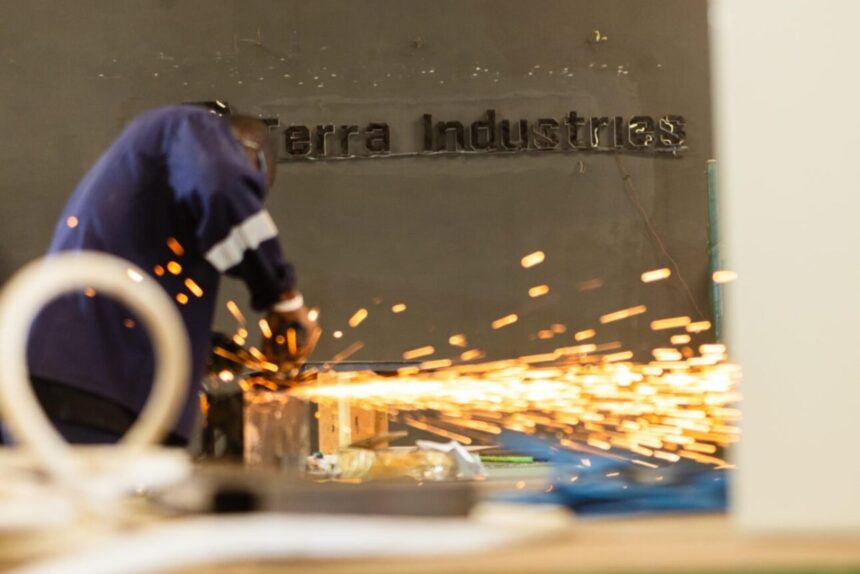
Terra Industries, Africa’s defence technology startup, is constructing a 34,000-square-foot drone manufacturing facility in Accra, Ghana, as it seeks to position itself at the centre of the continent’s rapidly evolving security landscape.
The plant, named Pax-2 is expected to become Africa’s largest drone production facility when it begins operations in June 2026, marking Terra’s first major manufacturing expansion outside Nigeria.
The Accra facility will more than double Terra’s current manufacturing footprint, surpassing its 15,000-square-foot flagship plant in Abuja. Once fully operational, Pax-2 is projected to produce up to 50,000 drones annually by 2028.
Terra’s leadership has framed the expansion as part of a broader effort to build indigenous defence capabilities across Africa.
“The only way Africa can have lasting peace is by uniting to build sovereign defence, not by relying on foreign security architecture,” Nathan Nwachuku, Terra’s co-founder and chief executive, stated in a statement.
He added that Ghana was selected for its engineering talent base and what he described as the country’s “political will to become a serious defence exporter”.
What You Need to Know
The expansion comes against the backdrop of escalating drone warfare across the Sahel, where extremist groups linked to al-Qaeda and Islamic State have increasingly deployed unmanned aerial systems in attacks.
Jama’at Nusrat al-Islam wal-Muslimin (JNIM), an al-Qaeda-affiliated coalition operating in Mali and Burkina Faso, carried out at least 89 drone operations between 2023 and 2025.
In January 2026, Islamic State Sahel Province launched a suicide drone attack targeting Niamey International Airport, highlighting the growing sophistication of non-state actors.
Expanding Product Portfolio
Pax-2 will manufacture three of Terra’s core aerial systems, which are the Archer VTOL, a long-range surveillance and strike drone; the Iroko UAV, designed for rapid tactical deployment; and Kama, a newly introduced high-speed interceptor drone.
The facility is expected to create around 120 engineering jobs, further strengthening Ghana’s position as an emerging hub for advanced manufacturing.
Kama, capable of speeds of up to 300 kilometres per hour, is specifically designed for counter-drone operations, a segment that remains underdeveloped across much of the continent despite growing threats.
Industry analysts note that while several African militaries have invested in offensive drone capabilities, defensive systems capable of detecting and neutralising smaller, low-flying drones remain limited.
Funding Momentum and Business Model
Founded in 2024 by Nwachuku and Maxwell Maduka, Terra has raised $34 million in funding across two rounds in 2026, making it the most capitalised defence-tech startup in Africa.
An $11.75 million round led by 8VC in January was followed by a $22 million follow-on round led by Lux Capital, with additional participation from Resilience17 Capital, backed by Flutterwave chief executive Olugbenga Agboola.
The company operates a hybrid business model, supplying drone hardware bundled with its proprietary ArtemisOS software on a recurring-fee basis, an approach inspired by US defence technology firms such as Anduril and Palantir.
Terra says its systems are already deployed to protect approximately $11 billion worth of assets across eight African countries, including energy infrastructure, mining operations and oil facilities.
Strengthening Government Partnerships
The Ghana expansion follows a memorandum of understanding signed in February between Terra and Nigeria’s Defence Industries Corporation (DICON), aimed at establishing a joint venture for local assembly and training.
The agreement, enabled by the DICON Act 2023, integrates Terra into Nigeria’s formal defence manufacturing ecosystem and reflects a growing trend towards public-private partnerships in the sector.
The company has also bolstered its leadership team, appointing counter-insurgency specialist Nnamdi Chife as Vice President of Military Relations.
Construction of the Pax-2 facility is nearing completion, with operations expected to commence by the end of June 2026.
For Terra, the next phase will be critical. While the company has secured significant funding and early traction, its ability to convert this momentum into long-term government contracts, particularly with emerging regional blocs such as the Confederation of Sahel States will determine its staying power.
Talking Points
It is striking that Terra Industries is scaling manufacturing capacity at a time when drone warfare is rapidly reshaping security dynamics across the Sahel.
The decision to build what could become Africa’s largest drone factory signals a clear shift towards localising defence production rather than relying on foreign suppliers.
At Techparley, we see this as part of a broader movement towards defence sovereignty, where African nations are beginning to invest in homegrown capabilities to address increasingly complex security threats.
The focus on counter-drone technology, particularly with the introduction of the Kama interceptor, is especially relevant given the growing use of low-cost drones by non-state actors.
This positions Terra not just as a drone manufacturer, but as a provider of critical defence infrastructure tailored to emerging threats on the continent.
As demand for both offensive and defensive drone capabilities grows, the gap in counter-drone systems presents a significant market opportunity that Terra industries is well-positioned to explore.
If successful, Terra industries could help reshape Africa’s defence manufacturing landscape, moving it towards greater self-reliance and technological capability.
——————-
Bookmark Techparley.com for the most insightful technology news from the African continent.
Follow us on Twitter @Techparleynews, on Facebook at Techparley Africa, on LinkedIn at Techparley Africa, or on Instagram at Techparleynews.