



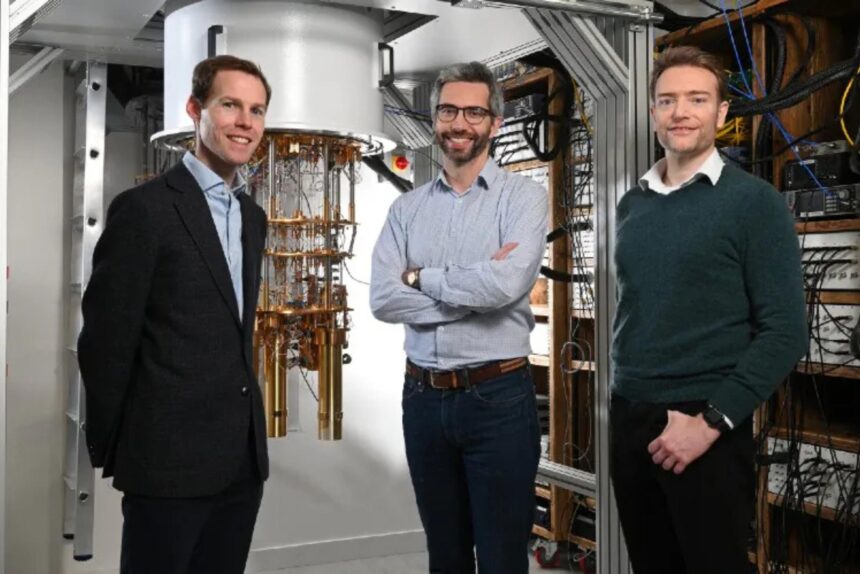
While much of the quantum computing industry continues to pursue highly specialised and expensive hardware systems, Quantum Motion is taking a radically different approach that could reshape the future of the sector.
The London-based quantum computing startup has raised $160 million in fresh funding as it pushes to build quantum computers using silicon manufacturing techniques already responsible for producing billions of conventional computer chips globally.
The funding round marks one of the most significant recent investments in Europe’s growing quantum ecosystem and reflects increasing investor confidence that scalable quantum computing may ultimately emerge from semiconductor manufacturing rather than highly customised laboratory hardware.
“Today’s announcement reflects the strength of the team we have built and the progress they have delivered. Quantum computing will only achieve its full potential if it can be built on a platform that scales, and we believe silicon is the strongest route to achieving that,” said Dr. James Palles-Dimmock, CEO of Quantum Motion.
Why the quantum industry is searching for scalability
Quantum computing has long been viewed as one of the most transformative frontiers in modern technology.
Unlike classical computers that process information using binary bits represented as either zero or one, quantum computers use qubits, which can exist in multiple states simultaneously through a phenomenon known as superposition.
That capability gives quantum systems the theoretical potential to perform calculations far beyond the reach of today’s most powerful supercomputers, particularly in fields such as materials science, drug discovery, logistics optimisation, artificial intelligence, cybersecurity, and financial modelling.
Yet despite years of research and billions of dollars in global investment, the industry continues to face one central problem: scalability.
Building quantum computers with enough stable qubits to perform commercially valuable tasks has proven exceptionally difficult. Many existing systems require fragile operating conditions, highly specialised cooling environments, and complex hardware setups that are difficult to manufacture at scale.
Quantum Motion’s strategy attempts to address that bottleneck by using a technology platform the semiconductor industry already understands deeply: silicon transistors.
What you need to know
In a traditional semiconductor chip, transistors control the flow of electrons by switching on and off. Quantum Motion’s architecture suspends a single electron inside the transistor gap and manipulates its spin state using magnetic fields.
That electron spin effectively becomes the qubit.
The idea of electron-spin qubits is not entirely new. Several companies, including Intel, have explored similar concepts over the years. However, maintaining stability while ensuring large-scale manufacturability has remained one of the industry’s biggest technical obstacles.
Quantum Motion believes its partnership with semiconductor manufacturer GlobalFoundries gives it a practical pathway towards industrial production by leveraging existing chip fabrication infrastructure rather than relying on entirely custom-built quantum systems.
What this means
The company’s long-term vision contrasts sharply with much of today’s quantum industry, where many firms continue to compete primarily on headline qubit counts and laboratory demonstrations.
Quantum Motion has instead focused heavily on manufacturability, industrial integration, and cost reduction.
Since its previous funding round in 2023, the company has expanded internationally with new offices and laboratories in Spain and Australia.
It has also strengthened its manufacturing collaboration with GlobalFoundries, directly linking its development roadmap to existing commercial semiconductor supply chains.
Lowering the cost of quantum computing
One of the company’s most ambitious claims relates to cost.
Quantum computers today often require highly specialised facilities and expensive infrastructure that can push deployment costs into hundreds of millions of dollars.
Quantum Motion believes silicon manufacturing could dramatically reduce those economics.
In 2025, the company said it achieved the world’s first commercial deployment of a full-stack silicon CMOS quantum computer at the UK National Quantum Computing Centre. It has also advanced to Stage B of DARPA’s Quantum Benchmarking Initiative, a programme designed to evaluate commercially viable quantum systems.
Palles-Dimmock said the company believes it could eventually build useful quantum computers for between $10 million and $20 million, significantly lower than many existing quantum hardware systems.
The latest funding round was co-led by DCVC and Kembara, with participation from British Business Bank and Firgun.
Existing investors including Oxford Science Enterprises, Inkef, Bosch Ventures, Porsche Automobil Holding, and Parkwalk Advisors also participated.
Quantum computing’s next commercial test
Despite growing momentum, quantum computing remains one of the most technically difficult sectors in the global technology industry.
Many companies have demonstrated promising laboratory breakthroughs, but few have shown a clear path towards reliable, large-scale, commercially affordable systems.
That is where Quantum Motion believes its semiconductor-first strategy may provide a competitive edge.
Rather than treating quantum computing as a niche physics experiment, the company is attempting to align the technology with the economics and scalability principles that already underpin the global chip industry.
If successful, the approach could fundamentally change how quantum computers are built, distributed, and commercialised over the next decade.
For now, the company’s $160 million funding round signals that investors are increasingly willing to back the idea that the future of quantum computing may ultimately be manufactured using the same silicon processes already powering modern digital life.
Talking Points
It is impressive that Quantum Motion is taking a radically different approach to quantum computing by building its systems using silicon manufacturing techniques already used across the global semiconductor industry.
This strategy directly addresses one of the biggest challenges facing the quantum sector today, which is scalability. While many companies continue to rely on highly expensive and complex hardware environments, Quantum Motion is positioning itself around a model that could make quantum computing more commercially practical and accessible.
At Techparley, we see this as a potentially important shift in how the industry evolves. The ability to leverage existing semiconductor infrastructure could significantly reduce production costs and accelerate the transition of quantum computing from research laboratories into real-world commercial deployment.
The company’s partnership with GlobalFoundries is also notable because it bridges advanced quantum research with established chip manufacturing ecosystems. That combination of deep scientific innovation and industrial-scale production capability could become a major competitive advantage in the years ahead.
Quantum Motion’s focus on manufacturability rather than headline qubit numbers also reflects a more long-term and commercially grounded strategy. In an industry often driven by experimental milestones, prioritising cost efficiency, reliability, and scalability may ultimately prove more valuable for mass adoption.
——————-
Bookmark Techparley.com for the most insightful technology news from the African continent.
Follow us on Twitter @Techparleynews, on Facebook at Techparley Africa, on LinkedIn at Techparley Africa, or on Instagram at Techparleynews.