



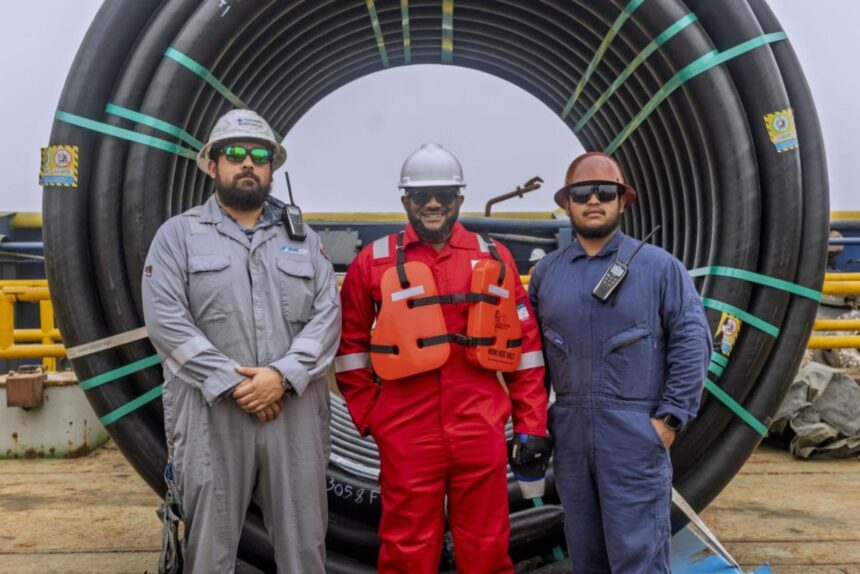
Nigeria’s offshore oil and gas sector has recorded a major infrastructure milestone following the successful completion of the country’s first deployment of FlexSteel Unbonded flexible pipeline technology by Kenyon International.
The project, executed at the ANTAN/ADANGA OML 123 Concession operated by NNPC Limited subsidiary NNPC Antan Producing Limited, signals what industry stakeholders describe as a turning point for offshore asset rehabilitation and indigenous engineering delivery in West Africa.
At the heart of the project was the installation of an 8-kilometre pipeline network comprising 4km of gas pipeline and 4km of oil pipeline linking the ADRP1 and ADNH offshore platforms.
The newly commissioned flowlines are expected to restore critical production capacity and contribute to Nigeria’s broader push to increase crude oil output amid ongoing efforts to stabilise production levels and improve revenue generation.
What You Need to Know
What makes the project particularly significant is the speed of execution.
Conventional offshore pipeline replacement projects in Nigeria and across many mature oil-producing regions typically require between two and three years due to extensive marine logistics, offshore welding operations, environmental permitting processes, and procurement bottlenecks.
Kenyon International, however, said it completed the planning, mobilisation, installation, and commissioning of the FlexSteel system within a dramatically shorter timeframe, compressing traditional project timelines by approximately 80%.
The development challenges longstanding assumptions about the pace at which offshore infrastructure projects can be executed in Nigeria’s energy sector, especially by indigenous firms.
Industry analysts say the achievement also highlights the increasing role local engineering companies are beginning to play in addressing production bottlenecks that have weighed on Nigeria’s oil sector in recent years.
Nigeria has struggled with ageing infrastructure, pipeline vandalism, operational downtime, and underinvestment across several upstream assets. Delays in replacing or rehabilitating damaged offshore pipelines have often resulted in deferred production and rising operating costs for operators.
The ADRP1–ADNH deployment now offers what many observers consider a practical alternative to lengthy conventional replacement campaigns.
Why FlexSteel Technology Matters
The project also introduces a technology that could reshape offshore pipeline management across West Africa.
“This is a definitive moment for indigenous capacity in the global energy space,” said Dr Victor Ekpenyong, Chief Executive Officer and Managing Director of Kenyon International.
“We have moved beyond the conversation of ‘participation’ to a position of ‘leadership.’ By delivering a world-class underwater solution that would typically take two years, we have demonstrated that with the right technology and local expertise, Nigeria can solve its production bottlenecks faster and more cost-effectively than ever before.”
“Our goal was to provide NNPC Antan with more than just a pipeline; we provided a fast-track to revenue. This project is a win for the Nigerian economy and a signal to the global market that our indigenous firms are now the vanguard of offshore innovation,” he added.
What This Means
Developed by Houston-based FlexSteel Pipeline Technologies LLC, the FlexSteel Unbonded system uses corrosion-resistant composite materials designed to withstand harsh operating environments that often degrade conventional steel pipelines.
Unlike traditional offshore steel lines that require extensive welding and are vulnerable to corrosion over time, the composite-based system is designed with longer continuous pipe lengths that reduce the number of field connections and potential leak points.
The technology also offers smoother internal bore surfaces that improve flow efficiency while integrated insulation properties help minimise thermal losses during transportation of hydrocarbons.
Lower maintenance requirements and longer operational lifespan are expected to reduce lifecycle costs for operators already facing increasing pressure to improve efficiency and reduce downtime.
The technology has already been deployed in parts of the United States shale sector and Brazil’s offshore industry. The Nigerian deployment marks its entry into West Africa’s offshore energy market through indigenous execution.
A Broader Signal for West Africa’s Offshore Future
Beyond the immediate production gains, the successful commissioning of the ADRP1–ADNH flowlines is likely to have wider implications for offshore operators across West Africa.
Many operators in the region are currently managing ageing offshore assets while facing increasing pressure to boost production, reduce operating costs, and meet tighter environmental and operational standards.
Traditional offshore construction campaigns often involve prolonged shutdowns, large capital commitments, and exposure to fluctuating global supply chain costs. Faster deployment models using flexible composite technologies could provide a more commercially viable option for operators seeking quicker returns on investment.
The project also reinforces the growing importance of indigenous participation in technically demanding offshore operations, an area historically dominated by international engineering contractors.
Kenyon International’s role in providing the engineering execution, logistics coordination, and offshore installation capability demonstrates the evolving technical capacity of Nigerian firms within the upstream sector.
Talking Points
It is impressive that Kenyon International has successfully delivered Nigeria’s first FlexSteel Unbonded flexible pipeline deployment within a significantly compressed timeline.
In an industry where offshore pipeline rehabilitation can take years, achieving this level of speed and efficiency represents a major milestone for the country’s oil and gas sector.
At Techparley, we see this as a strong example of how local expertise combined with advanced technology can unlock faster and more cost-effective energy infrastructure delivery across Africa.
The adoption of FlexSteel technology is particularly significant because it directly addresses some of the biggest operational issues facing offshore assets, including corrosion, leak risks, high maintenance costs, and extended downtime. Its ability to reduce connection points while improving flow efficiency could help operators extend asset lifespan and reduce operational losses.
As Nigeria continues to pursue higher oil production targets, projects like this could redefine offshore asset management across West Africa. With sustained investment in local technical capacity and innovation, the country has an opportunity to position itself as a regional leader in offshore infrastructure execution.
——————-
Bookmark Techparley.com for the most insightful technology news from the African continent.
Follow us on Twitter @Techparleynews, on Facebook at Techparley Africa, on LinkedIn at Techparley Africa, or on Instagram at Techparleynews.